
Review · TOKYO
Tokyo: Meiji Shrine Walking Tour — Shinto & Imperial System
Tokyo gets quiet under these trees. I like the small groups of up to 10 and the way guides such as Keiko, Yuuka, Yuki, and Ayaka explain shrine manners instead of leaving you to guess. The path through roughly 100,000 trees also gives you a calm break from central Tokyo.
I especially like the mix of nature and modern Japanese history, from the sacred sake barrels to the story of Japan’s move from samurai rule to the modern imperial system. The main drawback is that the tour is English only, and the 90 to 135 minute length can vary, so you should leave some flexibility in your schedule.
Key things to know before you go
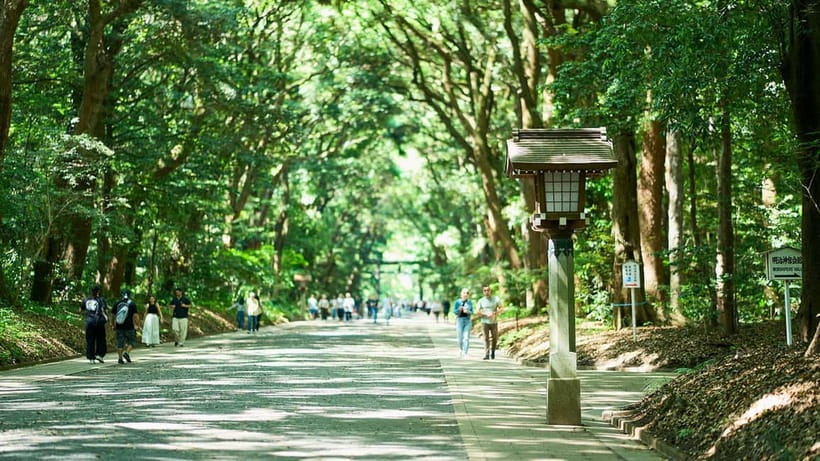
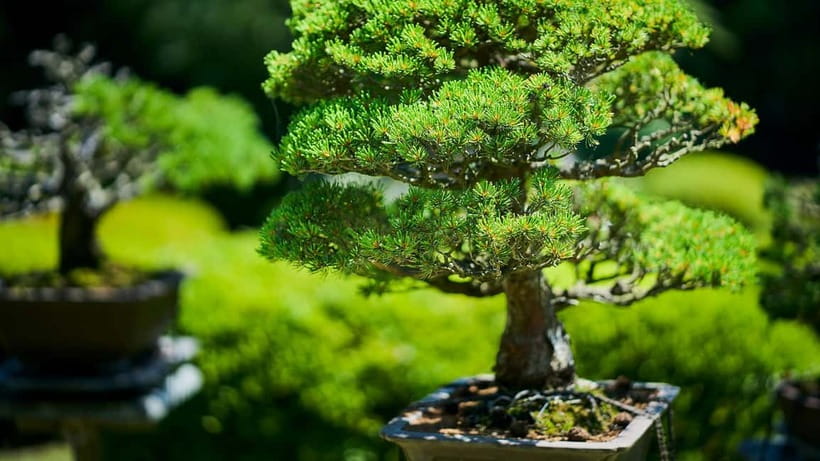
- The forest changes the mood quickly: Noise from Harajuku fades as you follow the shaded approach to Meiji Shrine.
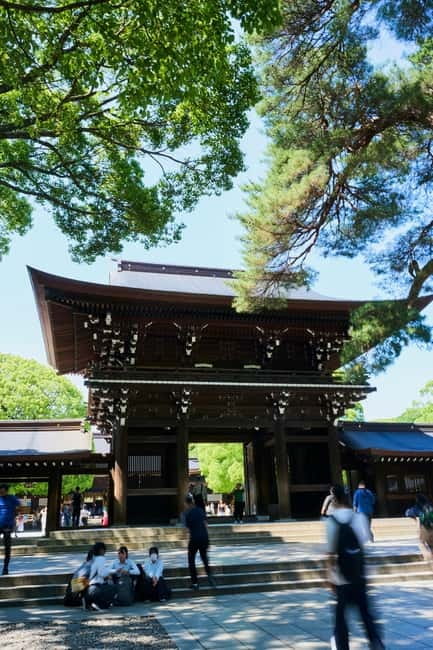
- The largest wooden torii is a major highlight: The 12-meter gate was made from a 1,500-year-old Taiwanese cypress.
- You learn how to behave at a Shinto shrine: Guides explain the central path, cleansing customs, offerings, prayers, fortunes, and charms.
- Imperial history is part of the visit: The tour connects Emperor Meiji and Empress Shoken with Japan’s shift into the modern era.
- The group stays small: With no more than 10 people, it is easier to ask questions and get help with unfamiliar customs.
- The price is modest for guided context: At $23 per person, you pay mainly for interpretation, practical help, and a more meaningful visit.
Why Meiji Shrine feels far from Tokyo
Meiji Shrine sits beside Harajuku, one of Tokyo’s busiest areas, yet its approach feels almost removed from the city. That change does not happen because the shrine is hidden. It happens because the trees absorb sound and the broad paths slow your pace.
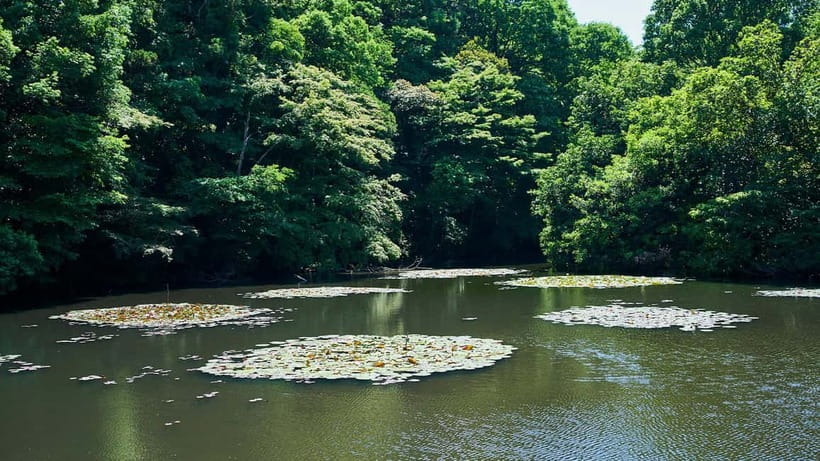
The forest contains approximately 100,000 trees. You will walk beneath shade, hear birdsong, and notice the city becoming less present with every step. I find this contrast more powerful than the shrine buildings alone. You begin in one of Tokyo’s most energetic districts and soon find yourself thinking about ritual, nature, and silence.
The tour starts at Harajuku Station, though the exact meeting point can vary by booking option. From there, your guide leads you toward the first torii, or shrine gate. The route is mainly on foot, so comfortable shoes make sense.
Your guide will likely set the tone early. The strongest guides on this experience, including Yuuka, Keiko, and Yuki, are praised for explaining difficult ideas in clear English and answering questions patiently. A few guides have also helped with photos, offerings, fortunes, and wishes, small acts that can make a first shrine visit much less awkward.
More Temple Walking Tours in Japan
- Tokyo: Asakusa Walking Tour with Sensoji Temple Visit
★ 4.8 · 1,583 reviews - Tokyo: Meiji Jingu Shrine and Shinto Culture Walking Tour
★ 5.0 · 245 reviews - Tokyo: Meiji Shrine and Shinto Culture Walking Tour
★ 5.0 · 225 reviews
Crossing the first torii with the right manners
The first major stop is Meiji Jingu Ichino Torii. In simple terms, a torii marks the entrance from ordinary space into a sacred area. It is not just a photogenic wooden frame, though you will certainly want a picture.
The guide explains how to approach the gate and how to walk through it respectfully. One useful detail is the central path, called seichu. It is traditionally reserved for deities, so you should keep toward one side rather than walking directly down the middle.
That is the sort of detail you may miss when visiting alone. There is no difficult ceremony to master, but knowing where to walk helps you feel less like you are wandering through someone else’s place of worship.
The tour does not treat Shinto as a list of strange rules. It explains the basic idea of respect for nature and harmony with the divine. You get enough context to understand why a forest, a gate, a water basin, and a wooden offering area all matter.
Reading the sake barrels and imperial connection
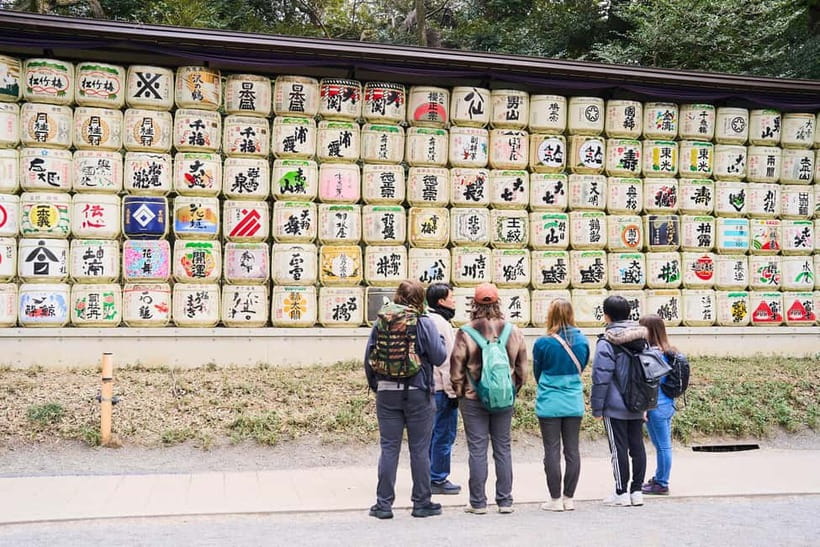
The next stops focus on consecrated wine and sake barrels. These barrels are displayed as offerings connected with the shrine, and they make an excellent pause for photographs.
Your guide explains the cultural role of sake and why the barrels appear at a major Shinto shrine. The stop is brief, but it gives you something concrete to look at while the larger story develops.
On the opposite side of the approach, you may see barrels associated with French wine. This creates an interesting visual contrast: traditional Japanese sake beside wine offered by a foreign producer. The point is not simply to admire colorful labels. It shows how Meiji Shrine reflects Japan’s relationship with both domestic tradition and the outside world.
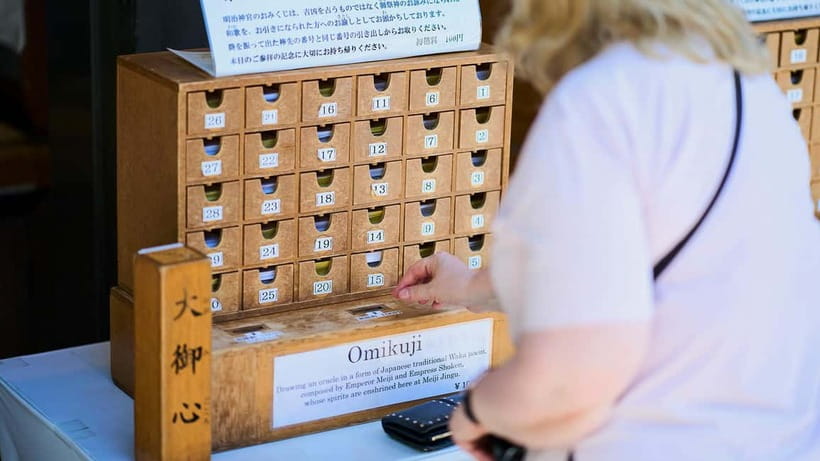
The tour then turns toward the imperial poetry connected with Emperor Meiji and Empress Shoken. Their poems are presented through an omikuji called Omigokoro, with English translations available. That translation matters. Without it, the poems would be attractive objects with meaning kept out of reach for many international visitors.
The poetry stop gives the imperial system a human dimension. Instead of hearing only about dates and political change, you encounter the words associated with the emperor and empress. It also helps explain why Meiji Shrine remains important to many people in Tokyo.
The 12-meter torii made from ancient cypress
The big torii is one of the most memorable physical sights on the route. It reaches about 12 meters high and was made from a 1,500-year-old Taiwanese cypress.
The numbers are striking, but the experience is more than a statistics lesson. The gate has a weight and scale that photographs do not fully capture. Your guide can point out its role in the approach and help you understand why passing beneath it feels like a clear transition.
Again, keep to the side of the path. The central route is considered sacred, so this is a good place to practice the etiquette you learned at the first gate.
There are several scheduled photo stops, but the tour is not simply a walk from one picture to the next. The best guides use these pauses to connect objects with ideas: trees with Shinto, barrels with offerings, and gates with the boundary between daily life and sacred space.
More Temple Walking Tours in Tokyo
- Tokyo: Meiji Shrine Walking Tour — Shintoism & Imperial System
★ 5.0 · 209 reviews - Tokyo: Asakusa Temple & Shrine Walking Tour with Local Guide
★ 5.0 · 105 reviews - Tokyo’s Kitchen: Tsukiji Market Food & Culture Walk
★ 4.7 · 74 reviews - Tokyo: Asakusa & Tokyo’s Oldest Temple Senso-ji Walking Tour
★ 4.6 · 21 reviews
At the main shrine, Shinto becomes practical
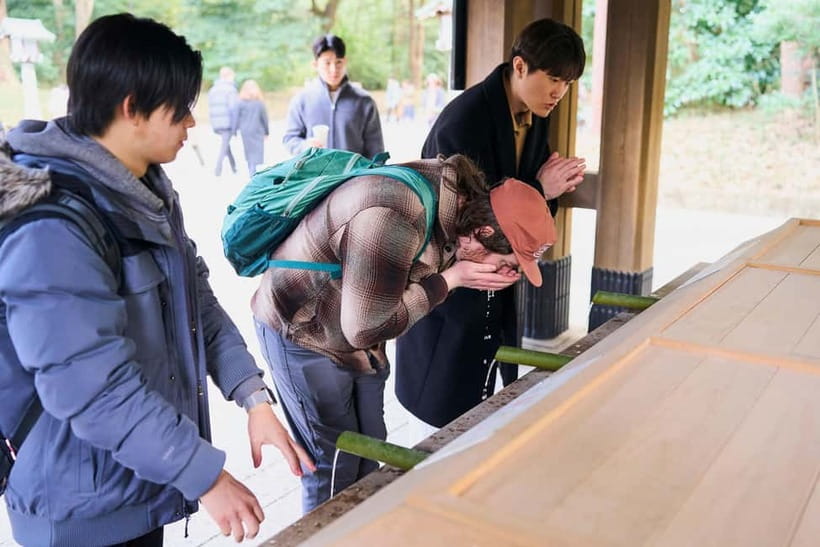
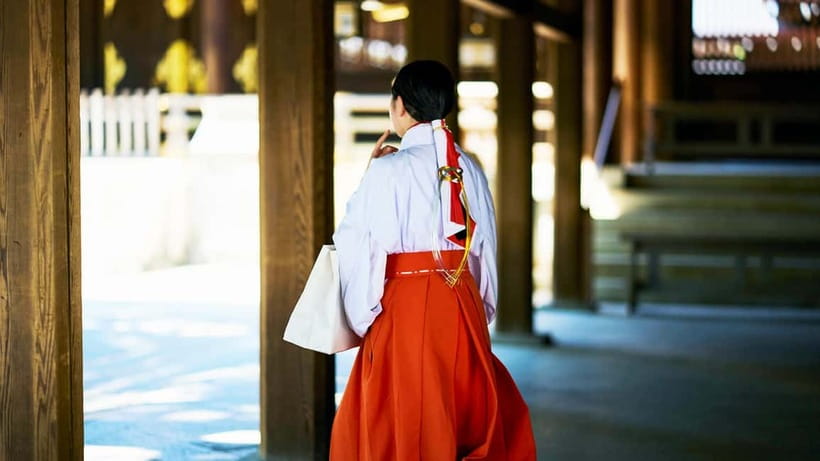
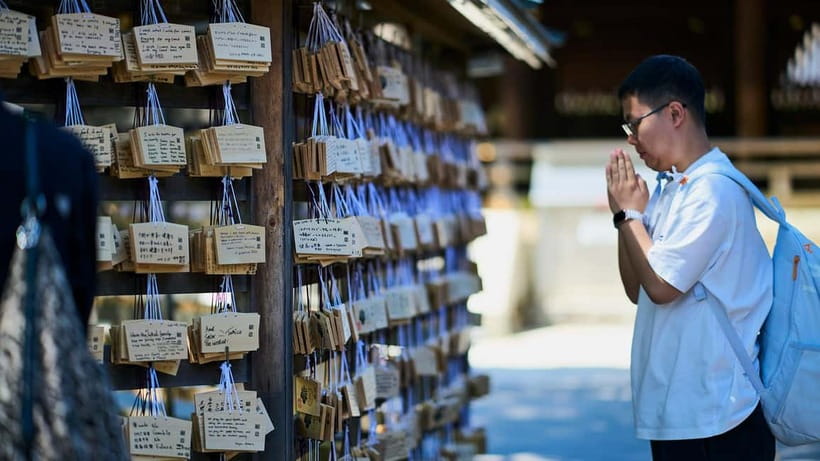
The main Meiji Shrine area receives the largest share of the tour, about 45 minutes. This is where you have time to look around, ask questions, make an offering, and shop for a charm or fortune.
Your guide explains how to approach the shrine and how to pay your respects. This is especially useful if you have never visited a Shinto shrine. You do not need prior religious knowledge, and the instructions are presented as practical cultural guidance rather than a test.
One particularly useful point is the distinction between a shrine and a Buddhist temple. The tour focuses on Shinto and the Meiji imperial story, but guides such as Nonoka and Ayaka have also explained the differences between Shinto and Buddhist customs. That background helps you recognize what you are seeing at other sites during your Japan trip.
You may buy an omamori, a protective charm, or choose an Omigokoro fortune. The English translations make the poems easier to understand, and the charms give you a personal souvenir rather than another generic Tokyo trinket.
The shrine can be especially busy on Sundays, holidays, and during seasonal events. One visitor described arriving on a busy Sunday and still finding the tour useful because the guide explained how to move through the site respectfully. The small group helps, but this remains a popular shrine in a major city. Do not expect complete solitude at the main buildings.
You might also see a traditional wedding or other ceremony. Such moments are not guaranteed, and the tour does not promise them, but the shrine is an active religious place rather than a museum. That is part of its appeal.
The story from samurai rule to modern Japan
The tour’s historical angle gives it more substance than a basic shrine visit. Meiji Shrine honors Emperor Meiji and Empress Shoken, and the guide uses their era to explain Japan’s transition from the samurai period into a modern state.
You learn about the imperial system and the broad changes associated with the Meiji period. The tour describes Japan’s movement toward modern institutions while keeping the focus on the shrine and its meaning.
This is where guide quality matters most. Yuki has been praised for explaining not only the shrine’s facts but also the spirit and customs connected with it. Yuuka has used old photographs to show what the area looked like before construction. Those visual references can make the historical change easier to grasp.
The stated theme includes Japan’s 2,600-year-old imperial system. You should not expect a full university course on Japanese political history in 90 to 135 minutes. You can expect a useful introduction that connects the imperial household, Shinto, Emperor Meiji, and the country’s rapid modernization.
I like this balance. The historical material is not detached from the place under your feet. You hear about modern Japan while walking through a shrine built in the early twentieth century and surrounded by a forest that feels much older.
Finishing at Mori no Terrace
After the shrine, the group walks to Forest Terrace Meiji Jingu and Café Mori no Terrace. The planned break lasts about 15 minutes and gives you time to sit, have Japanese tea, and enjoy a light snack.
This stop is a welcome change of pace. The shrine section asks you to pay attention to customs and history. The café gives you a short chance to relax and talk with the guide or other members of the group.
The gift shop has a few distinctive souvenirs. Eco-blocks made from fragrant Japanese camphor are more unusual than standard shrine merchandise, and miniature barrels of sacred sake make a memorable keepsake.
The café and shop are not the main reason to book the tour. If you want a long meal or a major shopping stop, this is not the right experience. Think of it as a comfortable finish and a chance to take home something connected to the visit.
The tour returns to Harajuku Station, with two possible drop-off locations listed around the station area. That makes it easy to continue toward Harajuku, Takeshita Street, or another Tokyo sight, though the tour itself does not promise a separate Takeshita Street visit.
What the small group adds
A limit of 10 participants is one of the best features here. Meiji Shrine is too large for a guide to explain every detail, but a small group lets you stop without blocking a crowd and ask direct questions.
Several guides have adjusted the pace to the group. One tour became almost private when only one person attended, while another guide waited for a late arrival and then tailored the explanations to that person’s interests. That kind of flexibility is difficult in a large coach group.
Guides have also helped with practical details. One supplied coins for an offering when participants did not have any. Others helped visitors write wishes, choose fortunes, take photographs, and understand the proper steps at the shrine.
Guide assignments vary, so you cannot choose Keiko, Yuuka, Yuki, Ayaka, Nonoka, or another particular guide unless the booking system specifically allows it. The repeated praise for these guides suggests a strong team, but the experience still depends on the person leading your departure.
Is $23 good value?
At $23 per person, this is inexpensive for a guided Tokyo experience lasting between 90 and 135 minutes. You are not paying for transport, an elaborate meal, or entry to a ticketed attraction. You are paying for access to explanations that make a free shrine visit easier to understand.
The value is strongest if this is your first time at a Shinto shrine. You learn how to enter, where to walk, how to make an offering, what the sake barrels mean, and how to use the shrine’s fortunes and charms.
It is also useful early in a Japan trip. One guide helped visitors understand differences between Shinto and Buddhism, haiku and waka, and basic shrine etiquette. That knowledge can help you at other religious sites later.
If you already know Japanese religious customs and have read about the Meiji period, you may find the tour less essential. You can walk through the forest and see the main shrine on your own. The guided value comes from context, translation, and the chance to ask questions.
The free cancellation period extends to 24 hours before the tour, and you can reserve now and pay later. Keep an eye on the exact duration and meeting point shown for your chosen departure, since both can vary.
Who should book this Meiji Shrine walk?
I would recommend it to first-time visitors to Tokyo, families who want help with shrine manners, and anyone interested in how religion and the imperial system shaped modern Japan.
It suits you if you prefer a calm walking tour with time for questions rather than a packed list of attractions. It is also a good first-day activity. The route is easy to connect with Harajuku, and the forest offers a gentle introduction to Tokyo after a long flight.
You should think twice if you want a completely independent visit, a Japanese-language tour, or a long historical lecture. The experience is in English only, and its history section is designed as an accessible introduction.
The walking route and 90 to 135 minute schedule also mean you should wear comfortable shoes and avoid booking something immediately afterward. The pace includes photo stops, free time, shopping, and a café break, but it is still a walking tour.
Should you book it?
Book this tour if you want Meiji Shrine to mean more than a large wooden gate and a few photographs. For $23, you get a small group, practical Shinto guidance, imperial history, translated poetry, and a peaceful walk through Tokyo’s remarkable forest.
I would especially choose it near the start of a Japan trip. The lessons about shrine etiquette, offerings, charms, and the difference between Shinto and Buddhism will help you everywhere else.
Skip it only if you are certain you prefer to explore alone or already understand the customs and Meiji-era background. For most visitors, the forest is beautiful on its own, but the guide is what turns the visit into a useful cultural experience.
FAQ
How much does the Meiji Shrine walking tour cost?
The tour costs $23 per person.
How long does the tour last?
The listed duration is between 90 and 135 minutes. The exact length depends on the departure option and availability.
Where does the tour begin?
The main starting point is Harajuku Station. The exact meeting point may vary depending on the option booked.
Where does the tour finish?
The tour finishes at two possible drop-off locations around Harajuku Station.
Is the tour conducted in English?
Yes. The live guide and tour service are English only. Japanese-language support is not available.
How many people can join the group?
The group is limited to 10 participants.
What can you see during the walk?
The route includes Meiji Jingu Ichino Torii, consecrated wine and sake barrels, the large torii, imperial poetry connected with Emperor Meiji, the main Meiji Shrine area, and Café Mori no Terrace.
Can you cancel for a full refund?
Yes. You can cancel up to 24 hours before the tour for a full refund. You can also reserve now and pay later.
More Meiji Shrine and Senso-ji Tours in Tokyo
- Tokyo Panoramic 1 Day: Meiji Shrine, Asakusa, Odaiba and SKYTREE®
★ 4.5 · 1,222 reviews - Tokyo: Asakusa and Tokyo’s Oldest Temple Senso-ji Tour
★ 4.9 · 352 reviews - Tokyo Morning Tour: Asakusa, Meiji Shrine and Tsukiji Fish Market
★ 5.0 · 128 reviews - Tokyo Morning Tour: Meiji Shrine, Asakusa & Fish Market
★ 4.9 · 44 reviews
Just added around Tokyo
- :Tokyo,Shibuya /Meiji Shrine tour in KIMONO/English-friendly★ 5.0 · 4 reviews
- Tokyo: Snow Monkey and Zenkoji Temple Day Trip In Low Price★ 5.0 · 5 reviews
- Tokyo War History Tour: Yasukuni Shrine & War Museum★ 4.5 · 6 reviews
- Tokyo: Gotokuji Culture Walk & Lucky Cat Temple Experience★ 4.9 · 5 reviews
- Tokyo: Shibuya Sky, Harajuku & Meiji Shrine Highlights Tour★ 4.5 · 9 reviews
- Tokyo: Visit 5 Shrines & Collect Goshuin on Private Tour★ 5.0 · 3 reviews
- Tokyo: Sensoji Temple & Street Food: Private Tour with guide★ 4.6 · 8 reviews
- Tokyo’s Kitchen: Tsukiji Market Food & Culture Walk★ 4.7 · 74 reviews
Meiji Shrine & Senso-ji Tours, compared.
Asakusa Walking Tour with Sensoji Temple Visit
Read our review →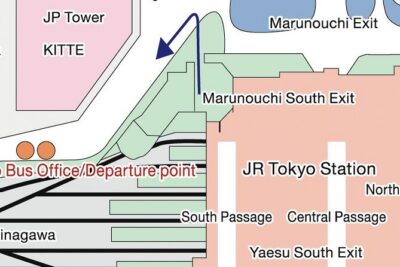
Tokyo Panoramic 1 Day: Meiji Shrine, Asakusa, Odaiba and SKYTREE®
Read our review →
Asakusa Senso-ji Temple and Old Tokyo Walking Tour
Read our review →
Asakusa and Tokyo’s Oldest Temple Senso-ji Tour
Read our review →
Meiji Jingu Shrine and Shinto Culture Walking Tour
Read our review →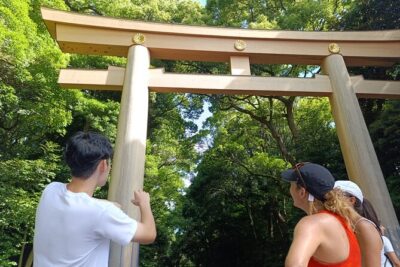
Meiji Shrine Walking Tour — Shintoism & Imperial System
Read our review →
Tokyo Morning Tour: Asakusa, Meiji Shrine and Tsukiji Fish Market
Read our review →Browse the lists this tour appears in