
Review · KYOTO
KYOTO: Golden Pagoda, Bamboo Forest, Arashiyama (Italian)
Kyoto reveals its quiet side here. This half-day outing links two of the city’s best-known sights, the Sagano Bamboo Forest and Kinkaku-ji, while an Italian-speaking Kyoto guide adds context about Japanese history, daily life, aristocratic retreats, samurai culture, and modern Kyoto. I especially like the included trains, buses, metro, and entrance fees, since moving between these northwestern sights can be confusing on your own. I also like the chance to ask questions in Italian rather than simply follow a guide holding up a flag.
The main consideration is time. Five hours gives you a useful introduction, but not a slow, unhurried visit to both areas. The Bamboo Forest includes a one-hour guided visit with time for sightseeing and shopping, while Kinkaku-ji receives about an hour. Crowds and walking conditions may affect your pace, so this suits you best if you want a well-organized first look rather than a full day in Arashiyama.
- Two famous Kyoto sights in one half-day: Visit the Sagano Bamboo Forest and Kinkaku-ji without arranging separate transport.
- Italian-speaking local guidance: The Kyoto guide explains the city’s past and present, including noble, literary, and samurai connections.
- Kyoto Station start and finish: The route begins at the north side of Kyoto Station and returns there by public transport.
- Transport and admission included: Trains, buses, the subway, and scheduled monument entrance fees are covered.
- Flexible finish: You may leave the tour partway through if you prefer to continue exploring independently.
- Strong guide-focused appeal: Guide Omae is praised for culture, humor, polished Italian, and unusual historical details.
Why This Route Works for a First Kyoto Day
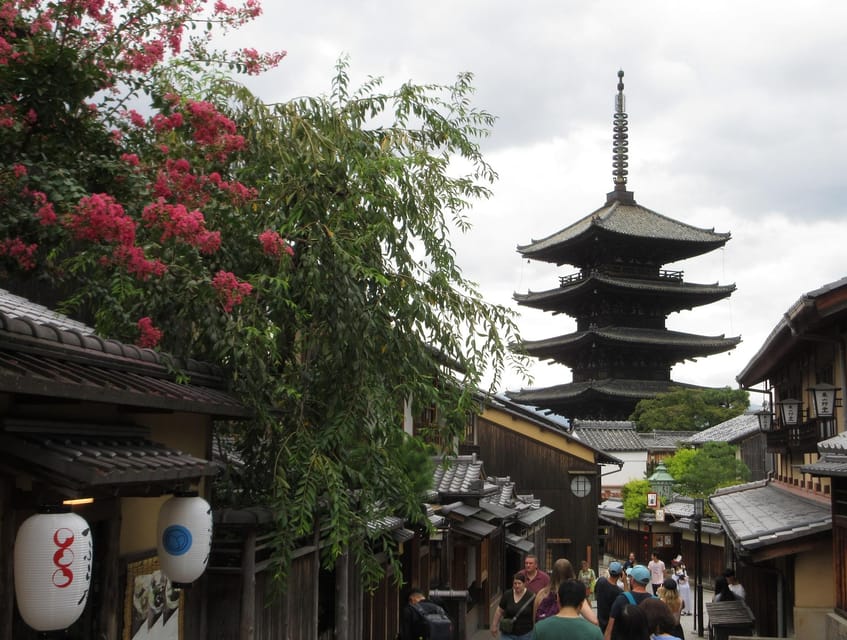
Kyoto can look simple on a map and feel complicated on the ground. The Bamboo Forest lies in Arashiyama, west of central Kyoto, while Kinkaku-ji sits farther north. This experience handles the connections for you, beginning and ending at Kyoto Station.
You first take a train for about 20 minutes to the Sagano area. After the Bamboo Forest, another train ride of about 20 minutes leads toward the next part of the route. A bus ride of roughly 15 minutes brings you to Kinkaku-ji, followed by another 15-minute bus journey and a 15-minute subway ride back to Kyoto Station.
That travel time matters. You are not spending five hours inside two compact sites. The day includes transfers, orientation, walking, sightseeing, and the guide’s explanations. The payoff is convenience and context. You see two very different sides of Kyoto without burning time studying route maps or working out which ticket to buy.
The meeting point is outside the central north entrance of Kyoto Station, on the east side of the space in front of the cab terminal. It is not at the bus terminal. Look for the area between the four escalators, with Kyoto Tower visible in front of you toward the upper left. The meeting details are confirmed by email by the day before, so read that message carefully.
Sagano Bamboo Forest: A Short Walk With Big Expectations
The Sagano Bamboo Forest is one of Kyoto’s most recognizable sights. The path moves through tall bamboo, creating a narrow green corridor that feels very different from the open spaces around the station and central city.
The scheduled visit lasts about one hour. That includes the guided walk, sightseeing, and time for shopping. You should think of this as a focused introduction, not an extended Arashiyama day. The route does not promise a full tour of every nearby temple, garden, or riverfront street.
A guide adds value here because the bamboo itself needs little explanation. You can see the tall stalks immediately. What you need is help understanding how this part of northwestern Kyoto connects with the old retreat culture of the area, where imperial relatives, aristocrats, and literary figures sought leisure away from the court center.
The tour also presents the forest as part of a wider preserved setting, not just a photo stop. That framing helps you notice the relationship between the natural surroundings and the refined country life once favored by people close to the imperial household.
You should allow for walking during this section. The exact pace is not stated, and the route may feel more crowded or slower at busy times. Comfortable shoes make sense. If your main aim is quiet photography, the one-hour schedule may feel brief. If your aim is to see the famous path and understand its place in Kyoto, the timing is practical.
Shopping is included in the Bamboo Forest portion. The details of the shops are not specified, so you should not expect a particular store or purchase. Treat this as a little free space within the visit rather than a major shopping excursion.
A few more temple visits around Kyoto worth a look
- Kyoto: Tea Ceremony Ju-An at Jotokuji Temple
★ 4.9 · 3,207 reviews - Arashiyama Bamboo, Temple, Monkeys, or Secret Sake Brewery
★ 4.8 · 886 reviews - Kyoto: Arashiyama Bamboo Forest, Monkeys, Matcha & Temple Tour
★ 5.0 · 759 reviews
Kinkaku-ji: Kyoto’s Golden Landmark
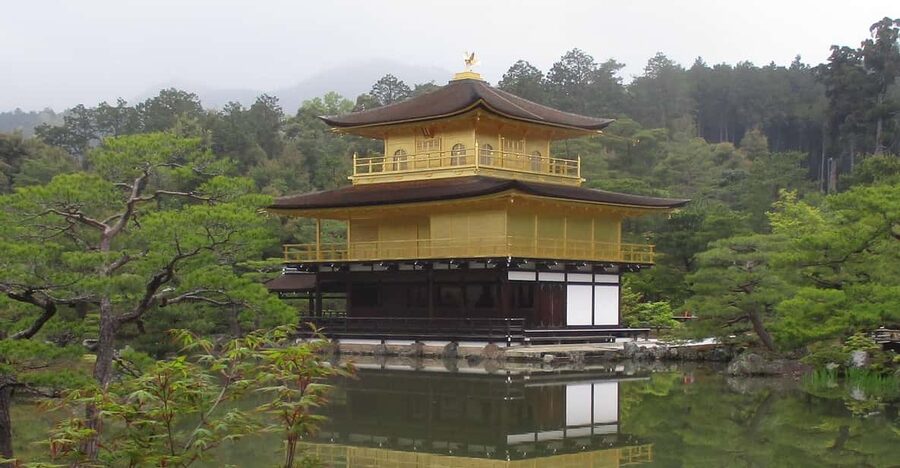
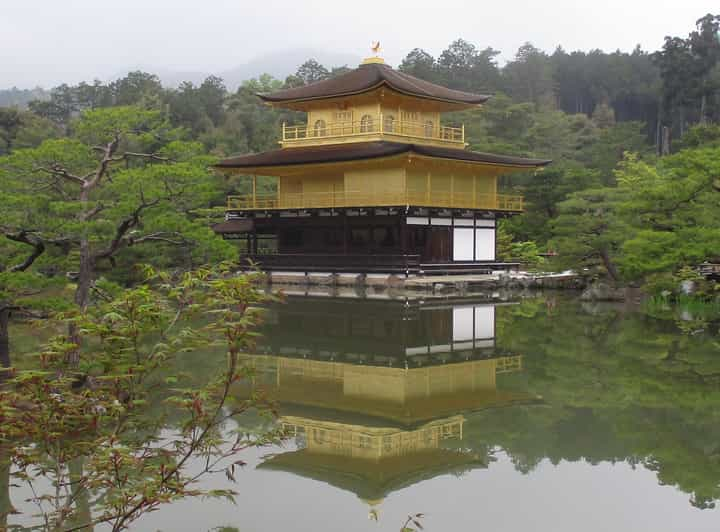
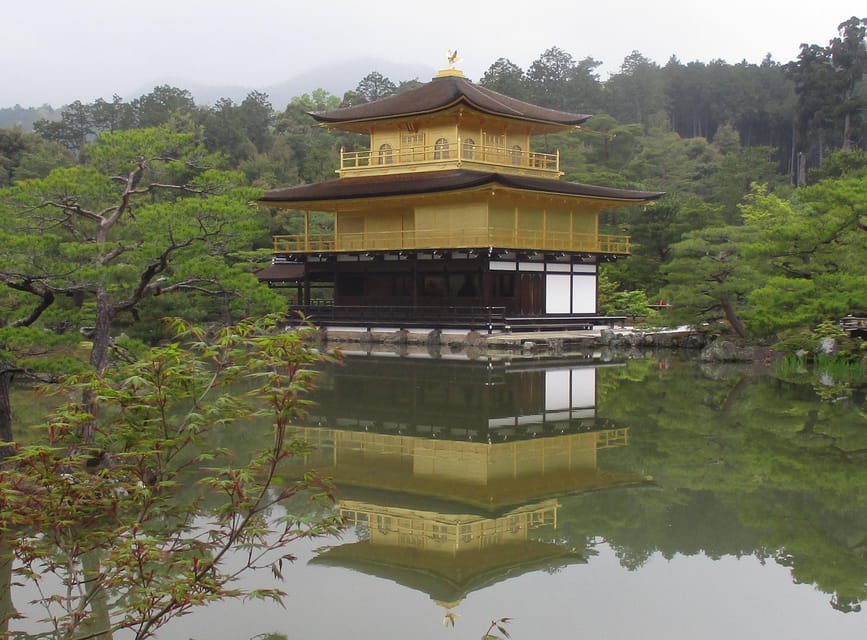
After the train connections and a short bus ride, you reach Kinkaku-ji, usually called the Golden Pavilion. The building’s bright gold exterior makes it one of Kyoto’s most immediately recognizable sights.
The visit lasts about one hour and includes a guide. That is enough time to see the pavilion and its setting, hear the main historical points, and move through the scheduled area without turning the visit into a long temple circuit.
The appeal here is visual, but the guide helps prevent the stop from becoming only a quick photograph. The experience focuses on the historical capital, the lives of old nobles and imperial relatives, and the links between Kyoto’s cultural traditions and the samurai class. You can ask questions about the building, the period around it, or modern Japanese life.
The tour description presents the site as part of the old leisure world of aristocrats and literati. That makes Kinkaku-ji a useful counterpoint to the Bamboo Forest. Arashiyama gives you a more rural setting, while the Golden Pavilion points toward the formal beauty and status culture associated with Kyoto’s ruling and educated classes.
One hour is a sensible amount of time for a first visit, but it comes with limits. You will not have unlimited time to pause at every viewpoint. If Kinkaku-ji is your main reason for coming to Kyoto, you may prefer a separate visit with more flexibility. If you want it paired with Arashiyama and handled by an Italian guide, the compact schedule works well.
A Guide Who Makes the Difference
The guide is the heart of this experience. The strongest praise centers on preparation, warmth, humor, and the quality of the explanations. One Italian guest specifically highlighted a prepared guide who avoided predictable commentary and created a friendly atmosphere.
Guide Omae receives special praise for cultural knowledge, good humor, polished Italian, and memorable curiosities about Kyoto. That is useful information when you are deciding between a simple sightseeing transfer and a guided experience. The sights are famous enough to visit alone, but a good local guide can connect them to the city’s social history.
You can ask questions about the historical capital, Japanese culture, daily life, and the difference between ancient and modern Japan. The experience is not limited to dates and architectural labels. It aims to show how nobles, literary figures, imperial relatives, and samurai lived and used the countryside around Kyoto.
The guide is described as native to Kyoto. That local connection matters because Kyoto has layers that are easy to miss when you only move from one famous monument to another. You hear about the preserved surroundings, the old retreat areas, and the ways the city remains connected to its past.
The exact group size is not provided. The activity can be arranged as a group or individual tour, so the feel may vary by booking. Ask about the format if personal attention is important to you.
The Public Transport Route, Step by Step
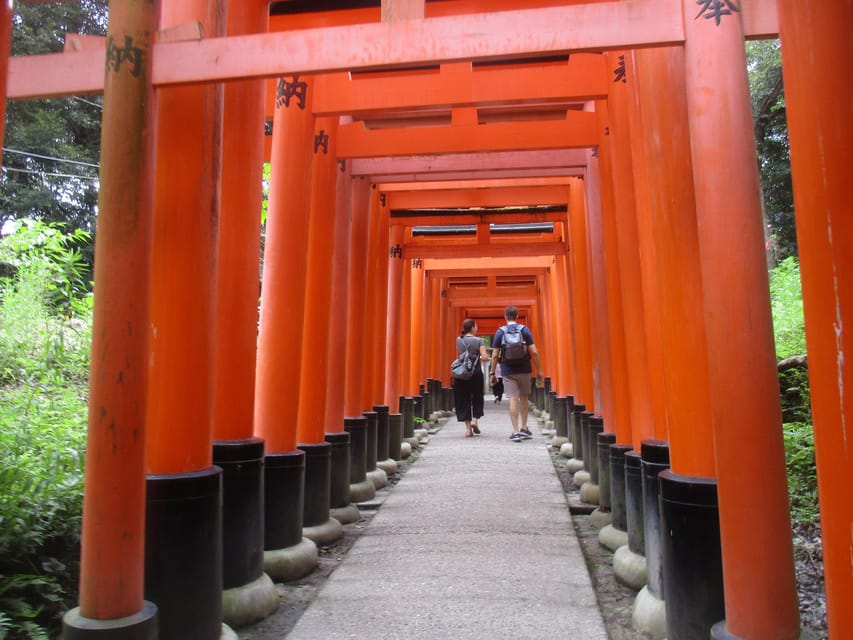
The transport plan is simple but worth understanding before you book. You begin at Kyoto Station, then take a train for around 20 minutes to reach the Sagano Bamboo Forest area.
After about an hour there, you take another train for roughly 20 minutes. A bus journey of about 15 minutes follows, bringing you to Kinkaku-ji. After the one-hour visit, you take a bus for about 15 minutes and then the subway for around 15 minutes back to Kyoto Station.
All scheduled transportation is included. Entrance fees for the monuments visited during the route are also included. That makes the $117 price easier to judge, especially if you value a guide in Italian and do not want to manage several separate fares.
Still, this is not a private vehicle tour. You will use public transport, which means transfers are part of the experience. The route gives you a more ordinary view of getting around Kyoto, but it can also feel less relaxed than traveling by car. Your guide handles the route, which is the main convenience.
The tour ends at Kyoto Station. You may also leave partway through, giving you some freedom if you want to remain in Arashiyama or stop after Kinkaku-ji. Because the return transport is built into the planned route, ask the guide before separating so you understand what part of the schedule you are leaving.
Same place, a different morning at the gates:
- Osaka/Kyoto:Kinkakuji,Arashiyama,FushimiInariShrine,NaraPark
★ 4.1 · 1,596 reviews - Kyoto Arashiyama Walking Tour: Bamboo, Monkeys, Gardens & Secrets
★ 5.0 · 1,216 reviews - Osaka/Kyoto: Arashiyama, Nara & Fushimi Inari Shrine w/Lunch
★ 4.4 · 754 reviews - Kyoto 1 Day Tour from Kyoto
★ 4.0 · 582 reviews
Is $117 a Fair Price?
At $117 per person, this is not the cheapest way to see the Golden Pavilion and Bamboo Forest. You can reach both areas independently using Kyoto’s public transport, and you could spend less if you already know the city and do not need explanations in Italian.
The value improves if you want several services combined: a native Kyoto guide, Italian-language commentary, public transport during the route, and entrance fees. You also save the planning work involved in linking Arashiyama with northwestern Kyoto in one morning or afternoon.
I would judge the price mainly by the guide. The buildings and bamboo are fixed attractions. The distinctive part is the interpretation, especially the discussion of old aristocratic retreats, literary culture, samurai life, and modern Japan. The comments about Omae suggest that the guide’s personality and cultural details can make the difference between a basic outing and a more rewarding one.
This is good value for an Italian-speaking visitor who wants structure and has limited time in Kyoto. It is less compelling for an independent explorer who enjoys figuring out train routes, reading signs, and spending as long as desired at each site.
Who Should Book This Half-Day Tour?
I would recommend it to you if Italian is your preferred language and you want historical explanation without joining a large international-language tour. It also suits first-time visitors who want to cover two major sights from Kyoto Station with the practical work handled.
It is a good choice for people who enjoy asking questions. The guide is there to discuss not only the monuments, but also Japanese daily life, history, culture, and the transition from ancient Kyoto to modern Japan.
The route can also work for visitors with a tight schedule. Five hours leaves the rest of your day open, and the tour returns you to Kyoto Station. That location is useful if you have a train to catch later or want to continue exploring central Kyoto.
The tour may be less suitable if you want a slow photography walk, a long stay in Arashiyama, or a full day of temples and gardens. The one-hour timing at each main stop is focused. You get range and guidance, not endless time.
The activity is listed as wheelchair accessible, though the exact conditions of every train, bus, and walking section are not described. If you use a wheelchair, confirm the practical route details before booking.
Booking Details That Matter
The tour costs $117 per person and lasts five hours. Starting times vary, so you need to check availability for your chosen date.
The meeting point is at Kyoto Station’s north entrance, also called Karasuma-guchi. Go outside to the space between the four escalators in front of the cab terminal. Do not wait at the bus terminal. Kyoto Tower should be visible in front of you, toward the upper left from this meeting area.
You receive a message by the day before with confirmation and more precise meeting instructions. I would arrive early. Kyoto Station is large, and a few extra minutes can save a rushed start.
The activity allows cancellation up to 24 hours before departure for a full refund. You can also reserve now and pay later, which helps if your Kyoto schedule is still changing.
Should You Book It?
Book this tour if you want Italian-language guidance, included transport, and a compact route through two major Kyoto sights. The strongest reason to choose it is the guide, especially if Omae is leading your departure. The comments about his culture, humor, polished Italian, and unusual facts point to an experience built around conversation rather than simple sightseeing.
Skip it if you prefer to travel entirely on your own or want several hours at one site. At $117, you are paying for organization, admissions, transport, and interpretation. For a first Kyoto visit with limited time, that package is sensible. For an experienced Kyoto visitor, the freedom of an independent day may offer better value.
FAQ
Where does the tour begin?
It begins at Kyoto Station’s north entrance, known as Karasuma-guchi.
What is the exact meeting area?
Meet outside the central north entrance, in the space between the four escalators in front of the cab terminal. This is toward the east side of the station. It is not the bus terminal.
How can I identify the meeting point?
From the meeting area, Kyoto Tower is visible in front of you toward the upper left. A message sent by the day before confirms and explains the meeting point.
Where does the tour end?
The planned route returns to Kyoto Station.
How long does the experience last?
The full tour lasts five hours.
Which language is the tour offered in?
The live tour guide speaks Italian.
Which sights are included?
The route includes the Sagano Bamboo Forest and Kinkaku-ji, the Golden Pavilion.
Is transportation included?
Yes. The scheduled trains, buses, and subway rides are included.
Are entrance fees included?
Yes. Entrance fees for the monuments scheduled during the route are included.
Can I leave the tour before it ends?
Yes. You are free to leave partway through the experience.
Is the activity wheelchair accessible?
Yes, the activity is listed as wheelchair accessible.
How much does the tour cost?
The price is $117 per person.
Just added around Kyoto
- Kyoto: Shakyo & Matcha in Historic Temple Garden★ 5.0 · 4 reviews
- Kyoto:Kiyomizu-dera Temple Rent a kimono and ride a rickshaw★ 4.8 · 7 reviews
- Kyoto: Kiyomizudera, Sanjusangendo, Ginkakuji and Higashiyama.★ 5.0 · 3 reviews
- KYOTO: Tempio Kiyomizu Pagode Gion “Geisya” (Guida Italiana)★ 4.7 · 17 reviews
- Kyoto:Quiet Arashiyama and Sagano Temples★ 4.8 · 5 reviews
- Kyoto: Kifune Shrine and the Sacred Kifune Valley Day Trip★ 4.4 · 4 reviews
- KYOTO: Tour guidato tra i tesori della città (in italiano)★ 5.0 · 5 reviews
- Kyoto : Kiyomizu-dera Temple : kimono and Indoor photo shoot★ 4.6 · 5 reviews
Kyoto Temple Tours, compared.
Osaka/Kyoto:Kinkakuji,Arashiyama,FushimiInariShrine,NaraPark
Read our review →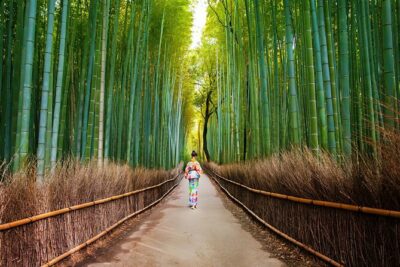
Kyoto Arashiyama Walking Tour: Bamboo, Monkeys, Gardens & Secrets
Read our review →
Arashiyama Bamboo, Temple, Monkeys, or Secret Sake Brewery
Read our review →
Arashiyama Bamboo Forest, Monkeys, Matcha & Temple Tour
Read our review →
Osaka/Kyoto: Arashiyama, Nara & Fushimi Inari Shrine w/Lunch
Read our review →
Kyoto Zen Meditation & Garden Tour at a Zen Temple with Lunch
Read our review →Browse the lists this tour appears in