Review · SIEM REAP
Siem Reap: Angkor Sunrise 1- or 2-Day Guided Temples Tour
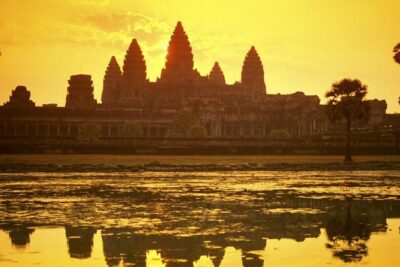
Sunrise makes Angkor Wat feel almost unreal. This tour combines the famous temple with Banteay Srei and the Grand Circuit, then adds Angkor Thom, Bayon, Ta Prohm, and a sunset stop over one or two carefully planned days. I especially like the small-group format, capped at 15 people, and the guide-led storytelling that gives meaning to carvings you could easily walk past.
I also like the practical care built into the day: an air-conditioned vehicle, bottled water, and cold towels after temple visits. Guides such as Sak, Pal Saruon, Sokpee, Pi, and Bun are repeatedly praised for clear explanations, local stories, and help with photographs. The main drawback is the pace. Day 2 begins around 4:20 AM, and the two-day plan covers a great deal of ground, so this suits an active schedule rather than a lazy holiday.
Key points at a glance
- Sunrise starts before dawn: Hotel pickup is usually between 4:20 and 4:35 AM, giving you time to reach Angkor Wat before the first light.
- Banteay Srei is the detail champion: Its small scale and finely carved sandstone make it very different from the massive central temples.
- Cold towels matter: After walking through hot temple grounds, the air-conditioned minibus, chilled water, and cool towels are more than a nice extra.
- The two-day plan has better variety: You see major icons, jungle ruins, quieter outer temples, a sunset, and several architectural styles.
- Guides help with photographs: Several guides are praised for finding less crowded viewpoints and taking pictures for solo visitors.
- The temple pass costs extra: The advertised tour price is $19 per person, but the required pass is not included and is listed at $62 per person for all temples.
What the $19 price really covers
At $19 per person, this is an inexpensive way to arrange transport and guidance around Angkor. The price covers hotel pickup and drop-off, an English-speaking guide, an air-conditioned vehicle, bottled water, and cool towels. For a full day, or two days of transport and explanation, that is good value.
But the headline price does not cover the temple pass. The supplied information lists a 2 to 3 day pass at $62 per person for all temples. Meals are also extra. Add those costs before comparing this tour with a private car, tuk-tuk, or another group excursion.
The value comes from the organization. Angkor is spread across a large area, and moving between temples takes time. You do not need to negotiate separate rides or work out the order of the sites yourself. A guide also points out religious symbols, stories, and architectural details that are easy to miss when you are walking alone.
The group limit is 15, though several recent departures were much smaller, with only five or six people. A smaller group makes it easier to hear the guide and keep the day moving. It also gives you a better chance of getting help with photographs without holding up a large crowd.
More Temple Sunrise Tours in Cambodia
- Angkor Wat Sunrise or Sunset Tour with Guide from Siem Reap
★ 5.0 · 12,109 reviews - Siem Reap: Angkor Wat: Small-Group Sunrise or Sunset Tour
★ 5.0 · 9,444 reviews - Siem Reap: Angkor Wat 2-Day Tour with Sunrise and Sunset
★ 4.9 · 4,429 reviews
Day 1: Pre Rup and the road to Banteay Srei
Day 1 usually begins around 7:40 to 8:10 AM, though the exact pickup time is supplied the day before. You travel in an air-conditioned vehicle, which is welcome because the temple grounds offer little shade during the hotter parts of the day.
The first stop is Pre Rup, a Hindu temple built in 961 or 962. Its laterite and sandstone construction gives it a sturdy, weathered appearance. The site is a useful opening lesson in the scale and purpose of Khmer temple building, though the steep steps can be awkward for anyone with limited mobility.
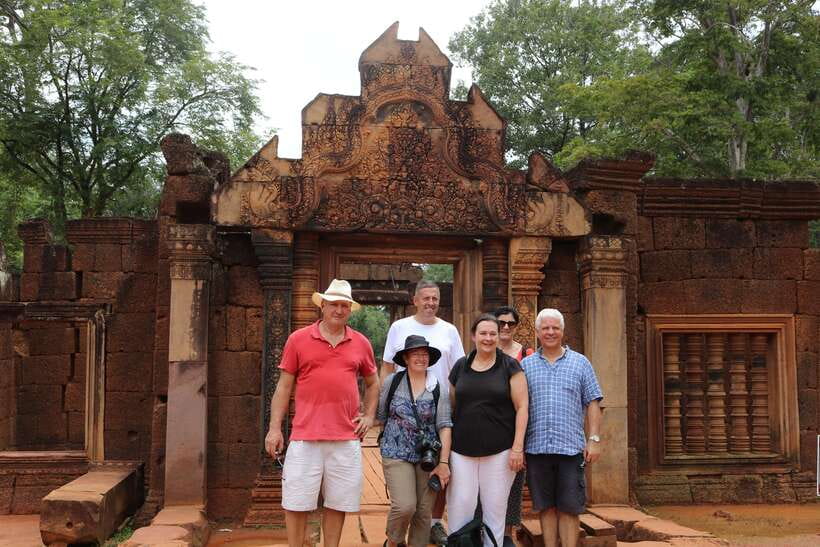
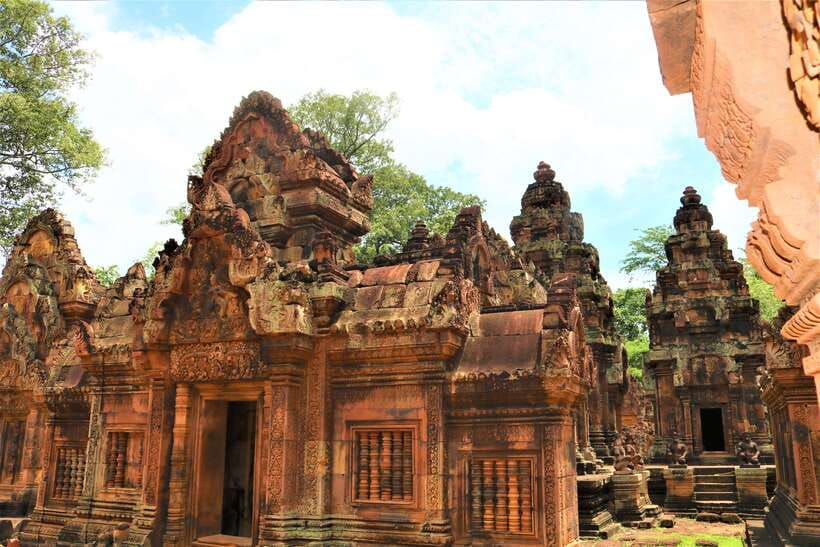
The main prize of the morning is Banteay Srei. This smaller sandstone temple is famous for extremely fine relief carving. Figures, floral patterns, and mythological scenes are cut with a delicacy that can be harder to appreciate on the giant walls of Angkor Wat.
Banteay Srei also changes the rhythm of the day. Instead of grand towers and enormous terraces, you get close to detailed stonework. Your guide can explain what the carvings show and why this temple is regarded as one of the most skillfully crafted in Cambodia.
The drive to the outer temples takes time, so Day 1 feels less like a quick highlights tour and more like a full archaeological circuit. If you prefer to stay close to Siem Reap and see only the major names, this may feel like too much road time. If you want a wider picture of the Angkor area, the distance is worthwhile.
Neak Pean and Preah Khan bring a different mood
Neak Pean is built on a circular artificial island in the Jayatataka Baray. Reaching it involves a walk across a long approach, with water and open space around the temple. The setting makes it different from the enclosed courtyards and tower-filled compounds elsewhere on the route.
It is not the biggest site, but that is part of its appeal. You get a change of pace after the carved surfaces of Banteay Srei and the broad stone platform at Pre Rup. Listen closely here, since the guide can provide the religious and symbolic context that is not obvious from the ruins alone.
Preah Khan is one of the most atmospheric stops. Its crumbling stone corridors and tree roots recall the jungle-temple image many people carry in their heads before arriving in Cambodia. The site was commissioned by Jayavarman VII in honor of his father and once served a large religious community.
Preah Khan is also a useful contrast with Angkor Wat. Angkor Wat feels ordered, monumental, and carefully framed. Preah Khan feels more layered, partly ruined, and intimate. Restoration work has helped preserve parts of the temple, while other sections retain a rougher character.
You will walk over uneven ground, around fallen stones, and up and down steps at several sites. Comfortable shoes are essential. This is not a good choice for wheelchair users, and the tour is not suitable for children under eight.
The sunset finish to Day 1
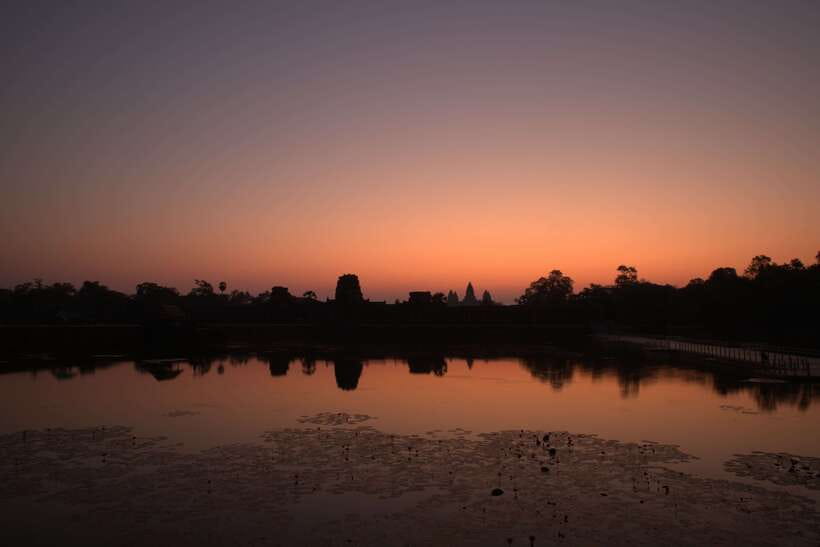
The first day ends with a sunset stop before returning to Siem Reap. The exact schedule can vary, and the supplied timing gives different estimates, ranging from about 4 to 5 PM to around 6 to 7:30 PM. Plan on a long day rather than relying on a precise return hour.
Weather controls this part of the experience. A clear evening can produce beautiful color, while cloud or rain may soften the view. One departure had cloudy conditions for sunrise but a superb sunset and even a rainbow afterward, a useful reminder that nature does not follow the brochure.
A sunset finish is also tiring. You have already visited several temples, and the heat can build during the afternoon. The regular water supply and cold towels help, but I would still carry sunglasses, a hat, insect repellent, and enough energy for the final stop.
More Temple Sunrise Tours in Siem Reap
- Angkor Wat Sunrise tour with Small – Group and Guide tours
★ 5.0 · 3,655 reviews - Angkor Wat Highlights and Sunrise Guided Tour from Siem Reap
★ 5.0 · 3,213 reviews - Full-Day Angkor Wat Sunrise Private Tour with Guide from Siem Reap
★ 5.0 · 2,920 reviews - Angkor Wat Sunrise & 3 Main Temples with Breakfast – Small Group
★ 5.0 · 2,857 reviews
Day 2 begins with Angkor Wat before dawn
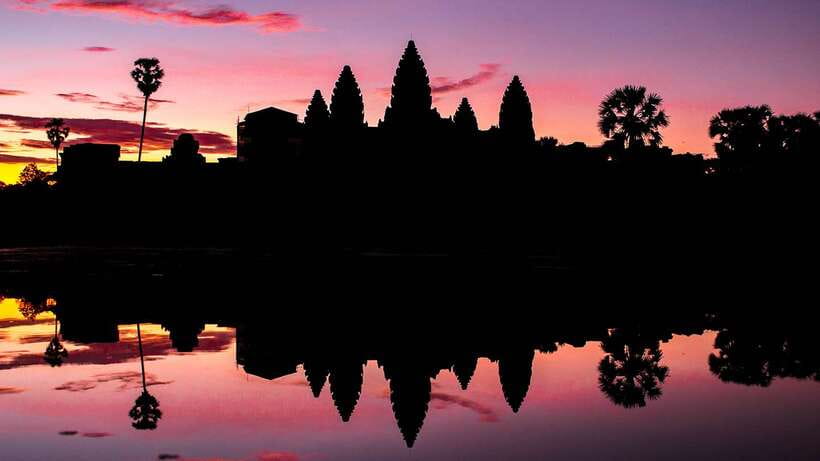
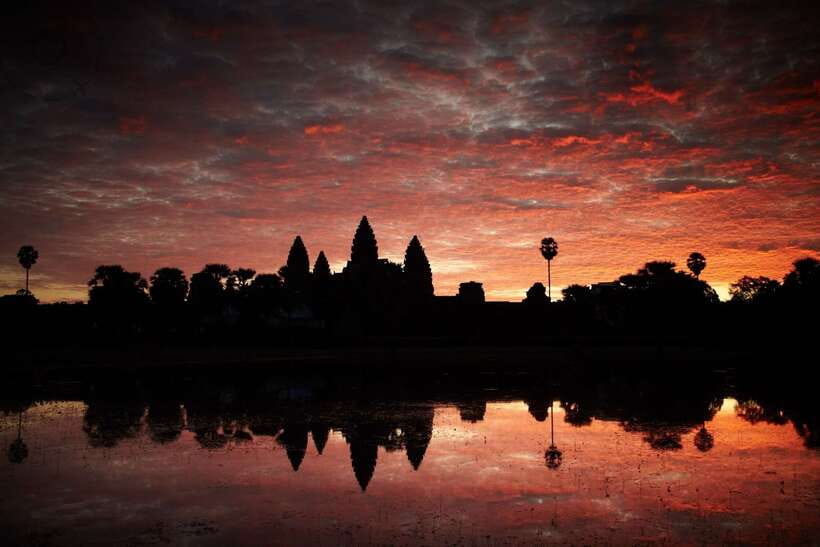
Pickup for the sunrise day is normally between 4:20 and 4:35 AM. This is the tour’s biggest logistical test. You need to be ready at the hotel well before sunrise, and you should expect some waiting at Angkor Wat because sunrise is one of the most popular moments at the complex.
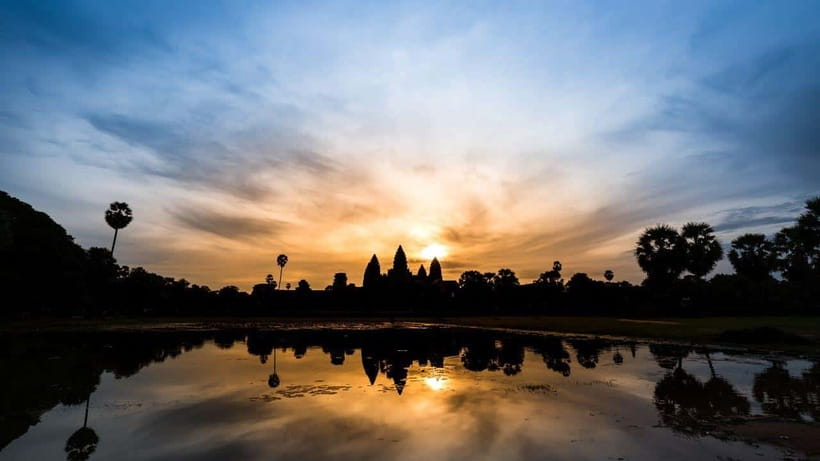
The advantage of an early guided arrival is that your guide can steer you toward a good viewing position. Sak was praised for helping his group reach the front area, while another guest preferred his suggestion of watching from a seated location along the outer wall rather than joining the tightest crowd by the moat.
The sky may be dramatic, or it may be cloudy. No guide can guarantee a perfect reflection in the water. What the tour can provide is a sensible arrival time, an experienced escort, and a chance to see the temple change from a dark silhouette to a detailed sandstone monument.
After the sunrise, you spend about two hours inside Angkor Wat. That time matters. The temple is not just a photo stop. You can walk through corridors, central chambers, and upper terraces while your guide explains the bas-reliefs, religious ideas, and stories linked to the Khmer Empire.
Angkor Wat was built as a Hindu temple and later became an important Buddhist site. The mixture of religious imagery and changing use is one reason a guide adds real value here. A good explanation helps you understand why the temple was designed as a series of galleries, towers, courtyards, and rising levels.
Breakfast is taken near the temple and is not included. Local restaurants are available, but bring some cash and do not assume that your favorite breakfast choice will be available. The stop is useful after the early start, though it adds to the overall cost.
Angkor Thom and Bayon: faces, gates, and royal scale
The next major section takes you through the Southern Gate of Angkor Thom. A row of 54 stone figures lines each side of the approach, with gods on one side and demons on the other. The scene gives you an immediate sense of ceremony and scale before you enter the fortified city.
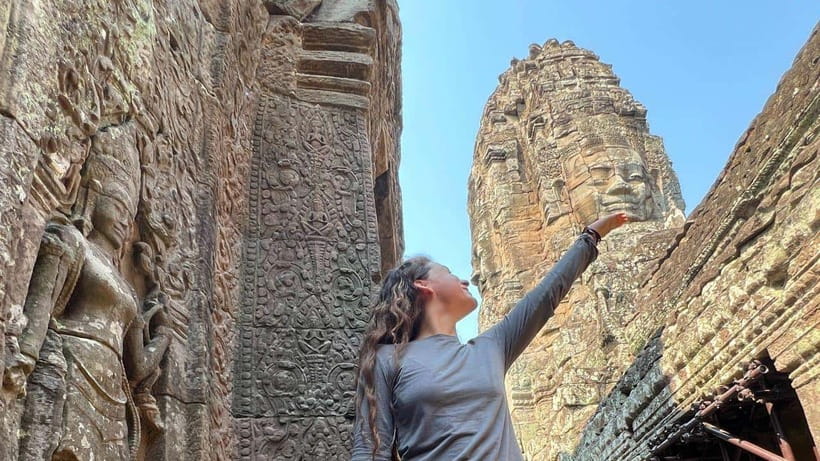
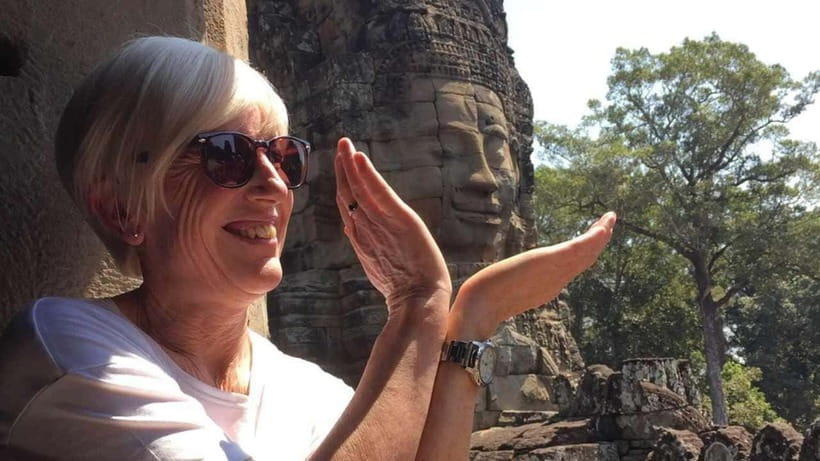
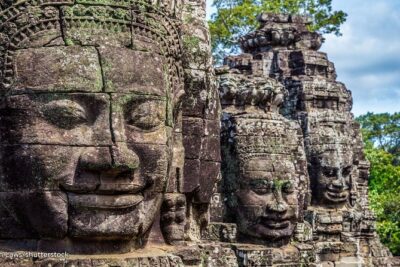
Inside Angkor Thom, Bayon is the visual star. Its central towers carry more than 200 enormous carved faces. You will see them from shifting angles as you move through the temple, and the expression can seem calm, watchful, or almost amused depending on the light.
Bayon is easier to appreciate with a guide because its structure can feel confusing at first. Towers overlap, galleries turn unexpectedly, and the faces appear at different heights. Your guide can help connect the layout with the royal and religious ideas behind it.
The tour also includes the Terrace of the Elephants and the Terrace of the Leper King. These are not simply quick photo stops. They help show how Angkor Thom functioned as a royal city, with ceremonial spaces and carved platforms rather than isolated temples scattered in the forest.
At this point, you may be ready for a break. The schedule is efficient, and one traveler described it as strict because the two-day plan covers so many places. The upside is that you see a wide range of sites in limited time. The downside is that you have less freedom to linger at every wall or return to a favorite temple.
Ta Prohm delivers the jungle setting
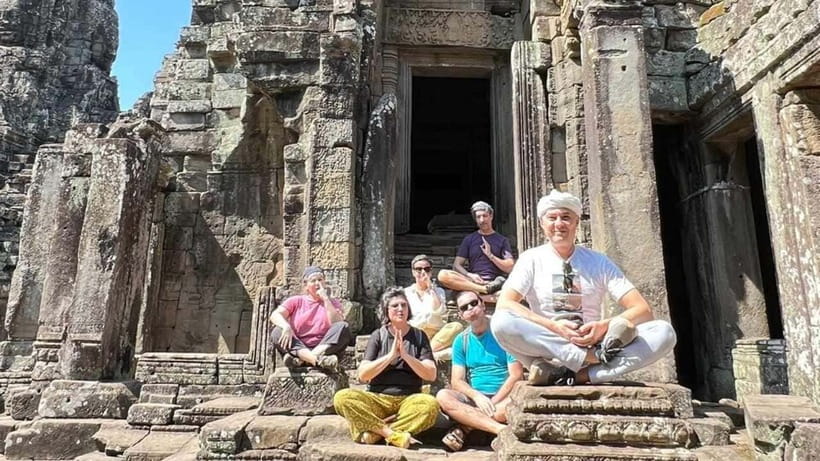
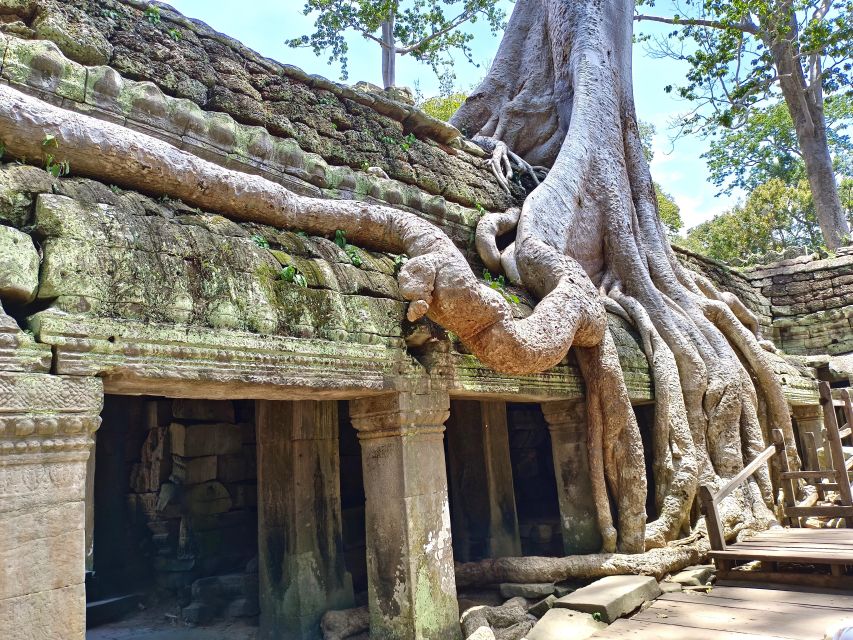
Ta Prohm is the final major temple on Day 2 and one of the most memorable stops. Tree roots press against walls and doorways, while sections of the complex remain visibly worn and broken. It is easy to see why this is often called the jungle temple.
Ta Prohm once housed almost 3,000 monks. That fact changes how you view the ruins. You are not just looking at roots and picturesque stone. You are standing in a place that once supported a large religious community.
The temple can be crowded, particularly around the best-known root-covered sections. Your guide may help you approach the busiest points at a sensible time and find other details nearby. Several guides, including Pal Saruon, Sak, Pi, and Sokpee, are praised for showing less crowded photo locations.
Ta Prohm is also physically demanding. The ground can be rough, and there are steps, rubble, and narrow passages. Wear shoes with a firm grip, keep your knees and shoulders covered, and avoid feeding animals. The clothing rule applies at the temples, so pack a light layer that covers you even if the morning begins cool.
The guides make the difference
The strongest part of this experience is the guide service. The names vary by departure, but the same qualities appear repeatedly: clear English, enthusiasm for Cambodian history, a good sense of humor, and help with photographs.
Sak is praised for connecting temple history with Cambodian culture and for finding strong sunrise positions. Pal Saruon is often noted for photo help and clear explanations of Hinduism, Buddhism, and the monuments. Sokpee is described as warm, funny, and attentive to the group’s pace.
Other praised guides include Pi, Bun, Chhay, and Sopheaprath. Their role is not just to recite dates. They explain daily life, local culture, religious ideas, and the meaning of scenes carved into the walls. That broader context gives the temples more human scale.
The guide also balances explanation with free time. Several people appreciated being given a talk at each site and then time to explore alone. That is the right approach for Angkor. Too little explanation leaves you guessing, while a nonstop lecture makes it hard to enjoy the place.
Photography help is a genuine bonus for solo visitors. Guides often take group pictures and suggest angles or less crowded spots. Still, do not treat this as a dedicated photography tour. The main service is guiding, and the schedule must work for everyone in the vehicle.
Transport, heat, and the long walking days
The air-conditioned minibus is an important part of the experience. You return to it between temples for shade, a cold drink, and a chance to cool down. Drivers such as Naro, Vichet, Ro, Mao, Seyha, and Keal are praised for safe driving and for having water and cold towels ready.
The towels are often scented or eucalyptus-like, according to the descriptions, and they are especially welcome after the hotter walks. You will still need to manage your own heat. Drink regularly, use sun protection, and take the shaded pauses offered by the guide.
The tour involves substantial walking over uneven ground. There are stairs, rubble, rough paths, and exposed temple courtyards. The activity is best for people who can handle several hours on their feet, even though the vehicle reduces the distance between sites.
The tour is conducted in English and is designed as a small group. Exact group size depends on the departure. Pickup and drop-off are included, but reconfirm your hotel details and watch for the final pickup time sent the day before.
What to pack and what to wear
Bring comfortable shoes, sunglasses, a sun hat, a camera, and insect repellent. I would also carry a small day bag with personal medication, tissues, and some money for meals and drinks.
Your knees and shoulders must be covered inside the temples. Shorts are not allowed according to the supplied rules, so loose trousers or a longer skirt are the safer choice. A lightweight shirt with sleeves also helps with sun exposure.
Do not count on the $19 price to cover food. Meals are not included, although you can buy them at local restaurants near the temples. Bottled water is included, but carrying your own refill or extra bottle is sensible on a long, hot day.
Is the one-day or two-day option better?
Choose the one-day sunrise option if Angkor Wat, Angkor Thom, Bayon, and Ta Prohm are your main priorities. It gives you the famous core sights and finishes around early afternoon, depending on the schedule.
Choose the two-day option if you want Banteay Srei, Pre Rup, Neak Pean, Preah Khan, and a sunset as well. The second day is not simply more of the same. The outer temples offer different sizes, settings, and states of preservation, which makes the overall visit more varied.
The tradeoff is stamina. Two days mean another early morning and a long first day. You also pay for the larger temple pass, although the pass covers the sites included in the wider route.
Should you book this Angkor tour?
I would book the two-day version if you have enough time in Siem Reap and want history explained rather than just transport between ruins. The combination of Banteay Srei’s fine carving, Preah Khan’s atmospheric corridors, Angkor Wat at sunrise, Bayon’s faces, and Ta Prohm’s roots gives you a strong introduction to the Angkor area.
The one-day choice works better if you are short on time or know that a 4:20 AM start and a full circuit will be enough for you. Either way, budget separately for the temple pass and meals, cover your shoulders and knees, and expect real walking.
This is a good-value guided outing for active visitors who want efficient transport, a small group, useful historical context, and practical care in the heat. It is less suitable if you want to move slowly, avoid early mornings, or spend an entire day at one temple.
FAQ
Is the temple pass included in the $19 tour price?
No. The temple pass is not included. The supplied information lists a 2 to 3 day pass at $62 per person for all temples.
What time does the sunrise day begin?
Pickup is usually between 4:20 and 4:35 AM. The exact time is provided one day before the tour.
How long is the two-day tour?
Day 1 begins around 7:40 to 8:10 AM and ends after the sunset visit. Day 2 begins around 4:20 to 4:35 AM and usually returns to the hotel between 12:30 and 1:30 PM. Published end times for Day 1 vary, so plan for a long day.
Are meals included?
No. Meals are not included, but you can purchase breakfast and other food at local restaurants near the temples.
What languages are available?
The tour includes a live English-speaking guide.
Is the tour suitable for children and wheelchair users?
It is not suitable for children under eight or for wheelchair users. The route includes uneven ground, steps, rubble, and considerable walking.
Can I cancel the booking?
You can cancel up to 24 hours in advance for a full refund. General last-minute date changes are allowed up to seven hours before the start time without an additional cost.
More 2-Day Experiences in Siem Reap
- 2 Days Exclusive Temple Highlights with Sunset and Sunrise Tour
★ 5.0 · 1,157 reviews - 2-Day Angkor Wat With Small, Big Circuit and Banteay Srei Tour
★ 5.0 · 545 reviews - Siem Reap: 2-Day Temple Highlights Sunrise and Sunset Option
★ 4.9 · 445 reviews - Angkor Wat 2-Day complex Sun rise & Sun set with Guided Tour
★ 4.9 · 439 reviews
More Angkor Wat Tours in Siem Reap
- Siem Reap: Full-Day Angkor Wat Guided Tour with Sunset
★ 4.9 · 3,803 reviews - Angkor Wat Sunset Small Group Tour with Lunch Included
★ 5.0 · 3,059 reviews - Siem Reap: Angkor Wat Sunrise and Full-Day Sightseeing Tour
★ 4.9 · 2,828 reviews - Siem Reap: Angkor Wat Private Tuk-Tuk Tour
★ 4.9 · 2,222 reviews
Just added around Siem Reap
- Sunrise at Angkor Wat Temple: 3-Hour Private Tour★ 4.7 · 30 reviews
- Small-Group Explore Angkor Wat Sunrise Tour with Guide★ 5.0 · 3 reviews
- Siem Reap: Ultimate Angkor Wat Offbeat Experience by Jeep★ 4.9 · 8 reviews
- SiemReap: Private Angkor Wat Tour in English or German guide★ 5.0 · 5 reviews
- Siem Reap : Private Tuk-Tuk Tour of the Magnificent Temples.★ 4.9 · 14 reviews
- Siem Reap: Private 4-Day Angkor Wat and Phnom Kulen Tour★ 5.0 · 9 reviews
- Siem Reap: Personalized Angkor Wat Sunrise/Set by TukTuk/Car★ 4.9 · 41 reviews
- Siem Reap: 1-Day Angkor Wat Tour in Portuguese★ 5.0 · 4 reviews
Angkor Wat Tours, compared.
Angkor Wat Sunrise or Sunset Tour with Guide from Siem Reap
Read our review →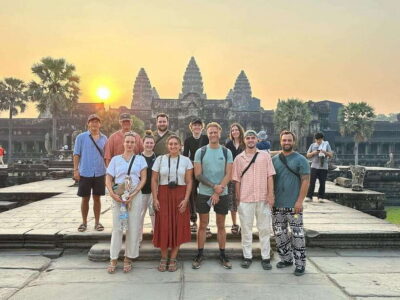
Angkor Wat: Small-Group Sunrise or Sunset Tour
Read our review →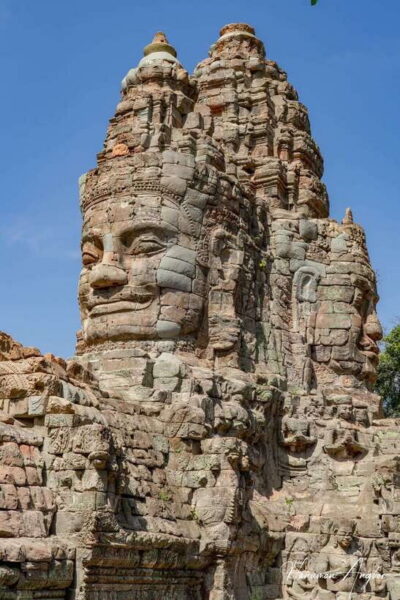
Angkor Wat 2-Day Tour with Sunrise and Sunset
Read our review →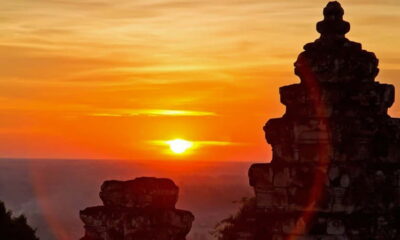
Angkor Wat Sunrise tour with Small – Group and Guide tours
Read our review →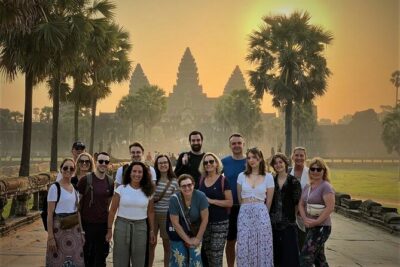
Angkor Wat Highlights and Sunrise Guided Tour from Siem Reap
Read our review →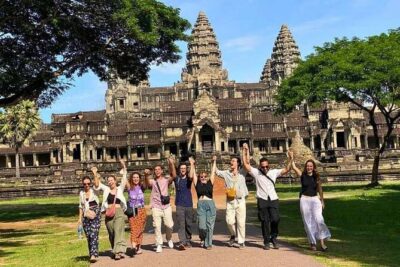
Angkor Wat Sunset Small Group Tour with Lunch Included
Read our review →