
Review · ROME
Rome underground hidden temples, ruins, and secret basilicas
Rome keeps its best stories underground. This compact experience leads you below the streets near the Colosseum, where churches, Roman houses, gladiator ruins, and a Mithraic temple sit one above another. I especially like the mix of major art and lesser-known archaeology, plus the short walking route between sites. The main drawback is that stairs and uneven surfaces make it unsuitable for wheelchair users.
The private guided option gives you a live English-speaking guide and includes all three locations. I also like the flexible audio version at San Clemente, especially if you prefer to move at your own pace. Just note the difference: the audio option covers San Clemente only, not San Pietro in Vincoli or the Ludus Magnus.
Key points before you book
- Three very different Roman sites: See Michelangelo’s Moses, a gladiator training complex, and three underground levels at San Clemente.
- A short route near the Colosseum: The sites are connected on foot, with no bus or taxi needed between stops.
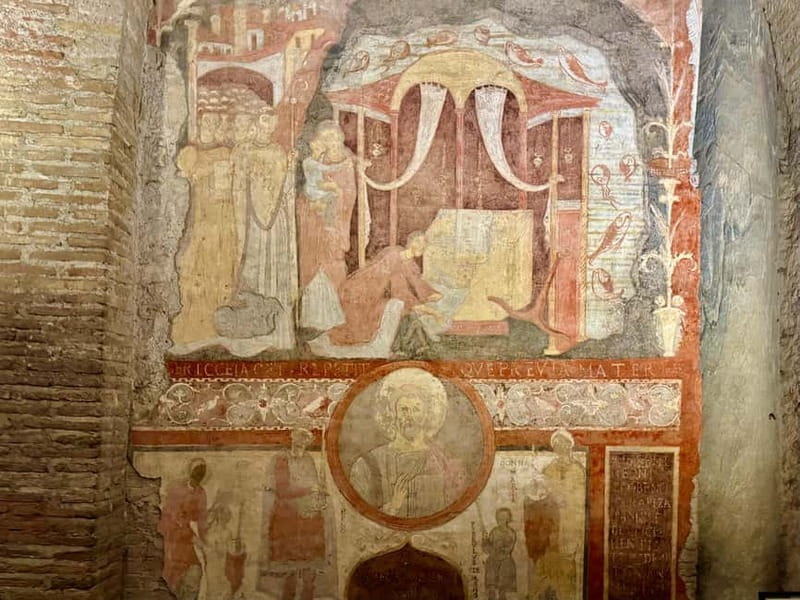
- The real highlight is San Clemente: You descend from a medieval basilica to an earlier church, a Roman house, and a Mithraeum.
- Two ways to visit: Choose a private guided tour or a self-guided audio experience focused on San Clemente.
- Excellent value at $31: The price is modest for entrance tickets and a private guide, though the audio option offers less coverage.
- Plan for church rules: Knees and shoulders must be covered, and comfortable shoes are essential.
Why Rome’s underground layers matter
Rome is famous for its monuments above ground, but the city’s lower levels often explain how those monuments survived and changed. Buildings were demolished, buried, rebuilt, and reused. A street level in one century could become a basement in the next.
That is the basic idea behind this experience. You are not simply visiting three unrelated stops. You are following a story of changing Rome, from the age of gladiators and private pagan worship to early Christianity and the grand churches of later centuries.
The route takes one to two and a half hours, depending on the option and pace. That makes it easy to fit beside a visit to the Colosseum, Roman Forum, or Monti neighborhood. It is also a good choice when you want something focused rather than another long day of monuments.
The private tour is the fuller experience. It includes San Pietro in Vincoli, the Ludus Magnus, and all three underground levels of San Clemente. The audio choice is more limited but gives you freedom to pause and explore San Clemente without staying with a group.
A few more temple visits around Italy worth a look
- Agrigento: Valley of the Temples Skip-the-Line Sunset Tour
★ 4.5 · 1,512 reviews - Pantheon Elite Guided Tour – Rome’s Iconic Ancient Temple
★ 5.0 · 1,447 reviews - Palermo: Agrigento and the Valley of the Temples Day Tour
★ 4.2 · 1,240 reviews
San Pietro in Vincoli and Michelangelo’s Moses
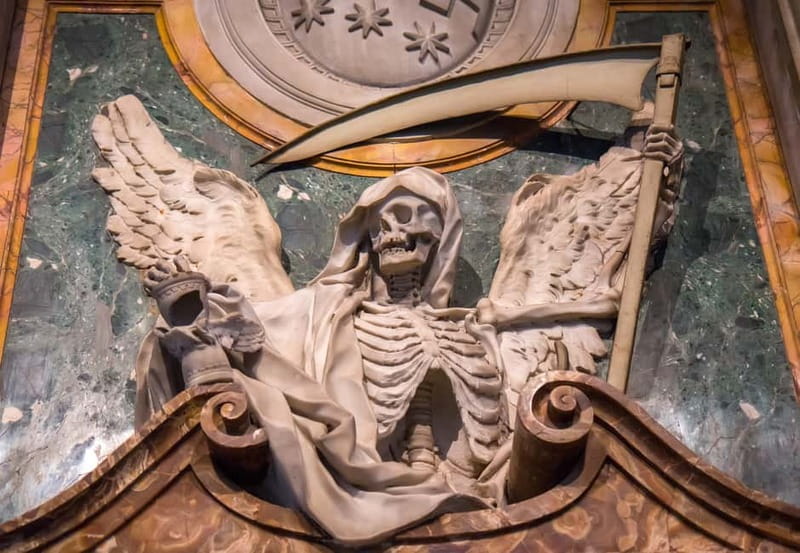
The first stop is the Church of San Pietro in Vincoli, reached from a small piazza near Via Cavour. The church is best known for two very different treasures: the chains associated with St. Peter and Michelangelo’s statue of Moses.
The chains are displayed in a reliquary and connect the church to the story of St. Peter’s imprisonment. The exact religious meaning matters less than the way the object gives the church a direct link to early Christian devotion. You are looking at a relic that has shaped the identity of this place for centuries.
Then there is Moses. Michelangelo created the statue for the tomb of Pope Julius II, and it has the force you would expect from one of the artist’s major works. Look closely at the beard, drapery, hands, and expression. The figure is not a distant, polished saint. It feels tense and human.
The stop lasts about 20 minutes, so you will not have unlimited time for quiet study. Still, that is enough to see the main works and hear the story behind them. If art is your main reason for booking, this church alone gives the outing real weight.
There is one practical point to remember. San Pietro in Vincoli is a functioning church, not just an archaeological attraction. Modest dress is required, with knees and shoulders covered for everyone. The rule is strictly enforced, so do not assume a hot Roman afternoon excuses shorts or bare shoulders.
The Ludus Magnus and Rome’s gladiator machine
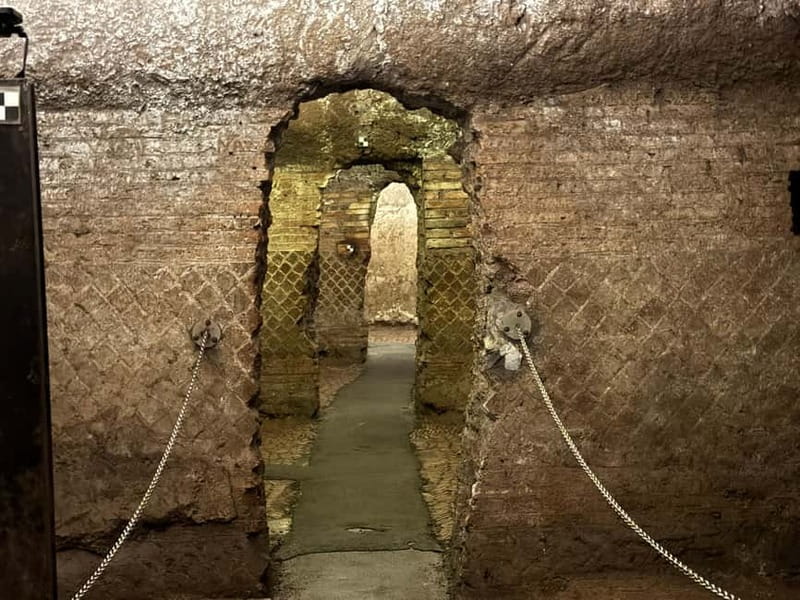
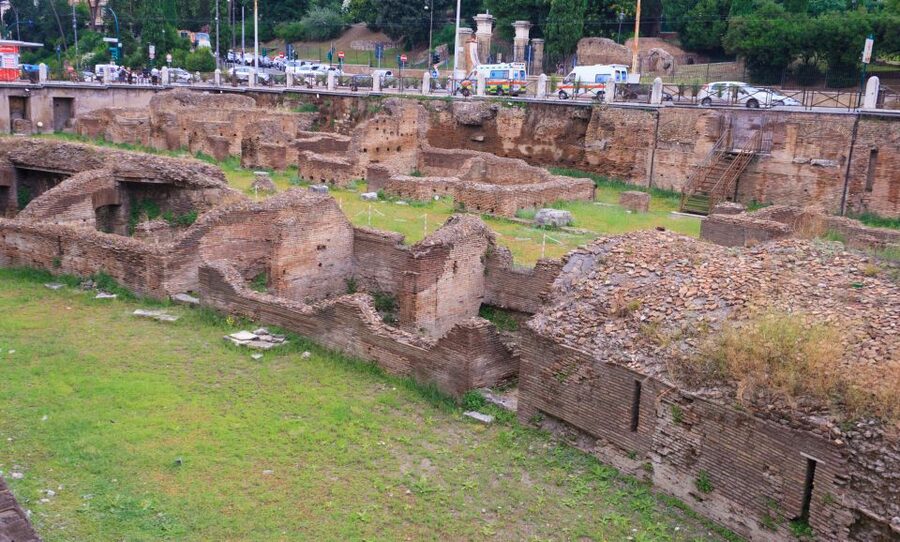
Next comes the Ludus Magnus, the ruins of an ancient gladiator training school. It once served as a place where fighters trained and lived before appearing in the Colosseum.
Only part of the complex is visible today, and the stop is brief, about 15 minutes. Do not expect a large, fully restored arena. What you get is a compact archaeological view of the system behind Rome’s famous games.
That distinction is important. The Colosseum shows the public spectacle. The Ludus Magnus helps you think about the preparation that made the spectacle possible. Gladiators needed housing, practice areas, equipment, and a connection to the arena. The training complex was linked to the Colosseum by underground passageways, allowing fighters and supplies to move between the two sites.
I like this stop because it gives the Colosseum more meaning. If you have already seen the arena, the ruins help fill in the practical details behind the grand building. If you have not yet visited the Colosseum, it gives you a useful preview without taking much time.
The drawback is that the ruins can feel visually modest beside Rome’s giant monuments. This is a stop for context rather than spectacle. Your guide matters here because a few clear explanations can turn low walls and foundations into a readable picture of ancient life.
San Clemente’s medieval church above the ruins
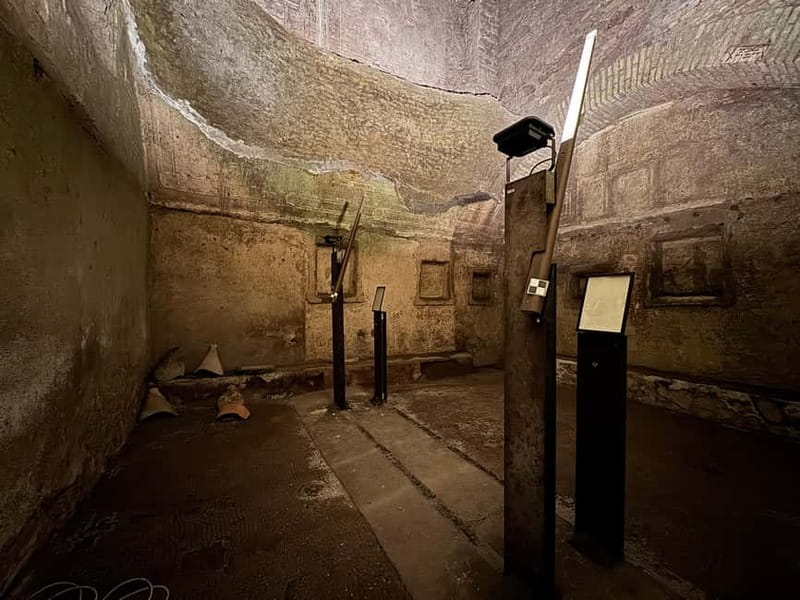
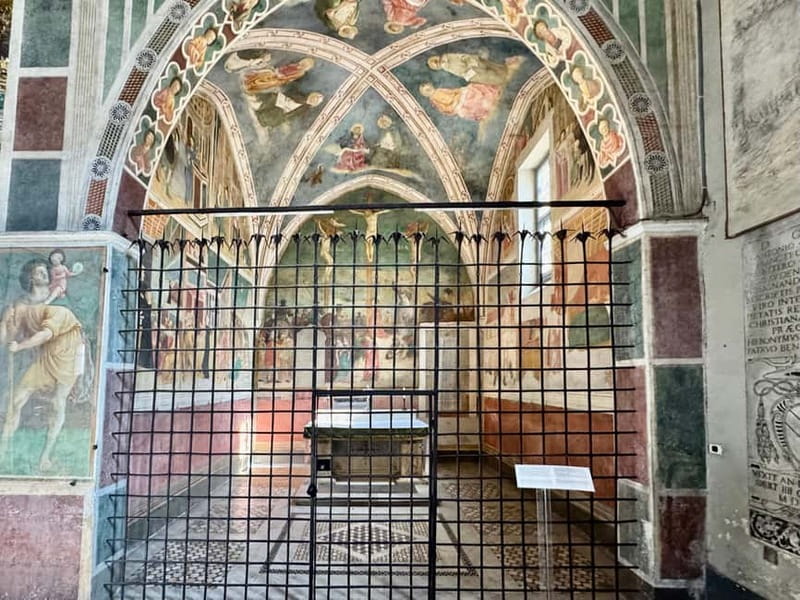
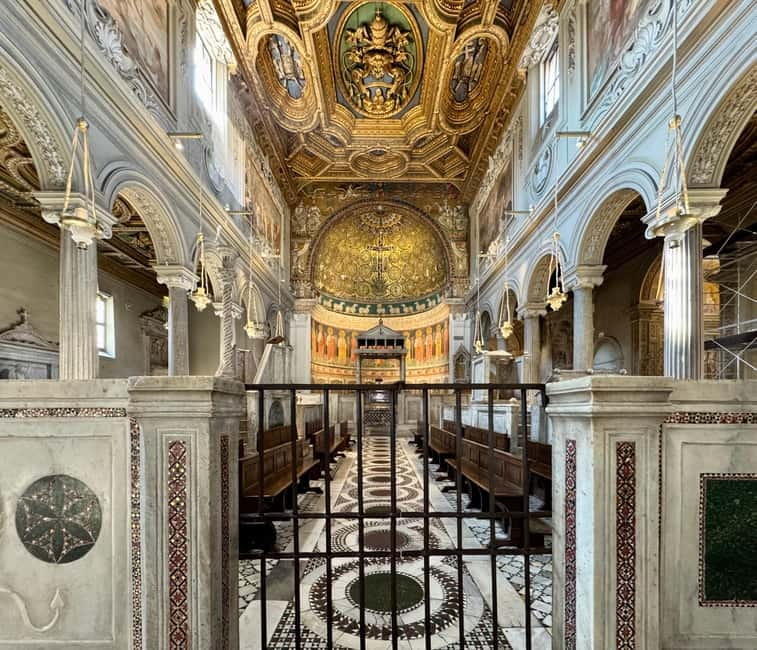
The final stop is the Basilica of San Clemente, the most layered part of the route. You begin in the upper church, a medieval basilica decorated with glittering mosaics. The space gives you the familiar Roman church experience: sacred art, polished surfaces, and centuries of worship.
Then the ground drops away.
San Clemente is valuable because the church was built directly over earlier structures. As you go downward, you move backward through time. The upper basilica belongs to the 12th century. Beneath it is a simpler 4th-century church. Below that are remains of a 1st-century Roman house and a Mithraeum.
That physical descent is the best feature of the entire experience. Instead of hearing that Rome has many layers, you can see those layers stacked in one place. The modern city is above you, the medieval church is around you, and older Roman spaces are below your feet.
The underground areas are atmospheric, but they are not effortless. Expect stairs, uneven surfaces, and enclosed passages. Anyone who dislikes cramped or dim spaces should keep that in mind. This is also why the site is not wheelchair accessible and does not accept non-folding wheelchairs, walking frames, or electric wheelchairs.
The San Clemente visit lasts about 45 minutes on the guided route. That is enough for a clear introduction, though you may wish you had more time in the lower levels. The audio option lets you set your own pace, which can be useful if you prefer to stop and listen carefully.
Same place, a different morning at the gates:
- Rome’s Iconic Temple: Pantheon Audio Guided Tour with Fast Access
★ 4.0 · 1,188 reviews - Agrigento: Valley of the Temples Ticket & App Audioguide
★ 4.3 · 1,160 reviews - Colosseum Special Access Tour, with Ancient Temples & Tombs
★ 4.8 · 747 reviews - Agrigento: Valley of the Temples E-Scooter Tour
★ 4.6 · 557 reviews
The 4th-century church and early Christian Rome
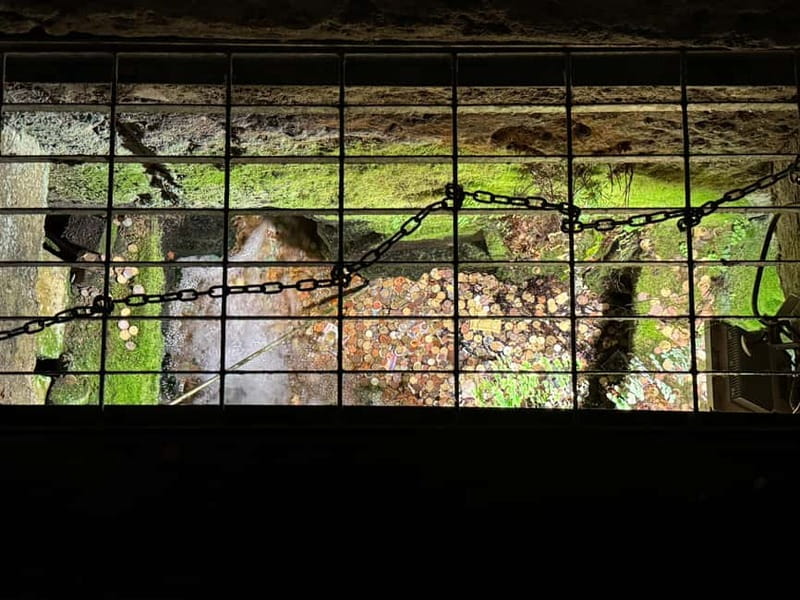
The middle level shows how Christianity took root in a Roman setting. The 4th-century church was built below the later basilica, so the space feels plainer and more enclosed than the upper church.
This part of the visit helps explain the transition from Roman pagan culture to Christian worship. The change was not a clean break. New churches often occupied places already used for homes, businesses, or religious ceremonies. San Clemente lets you see that process in physical form.
The middle level is also where the tour’s time-travel effect becomes strongest. A medieval worshipper stood above an earlier Christian congregation, which stood above an older Roman household and pagan sanctuary. You do not need to be an archaeology expert to understand the sequence.
A guide can add useful detail about how the levels were uncovered and interpreted. On the audio route, you can replay sections if the underground acoustics make listening difficult. Bring your own headphones. They are recommended for the best sound, and the app works best on a smartphone made in 2020 or later with a current operating system.
The Roman house and Mithraeum below San Clemente
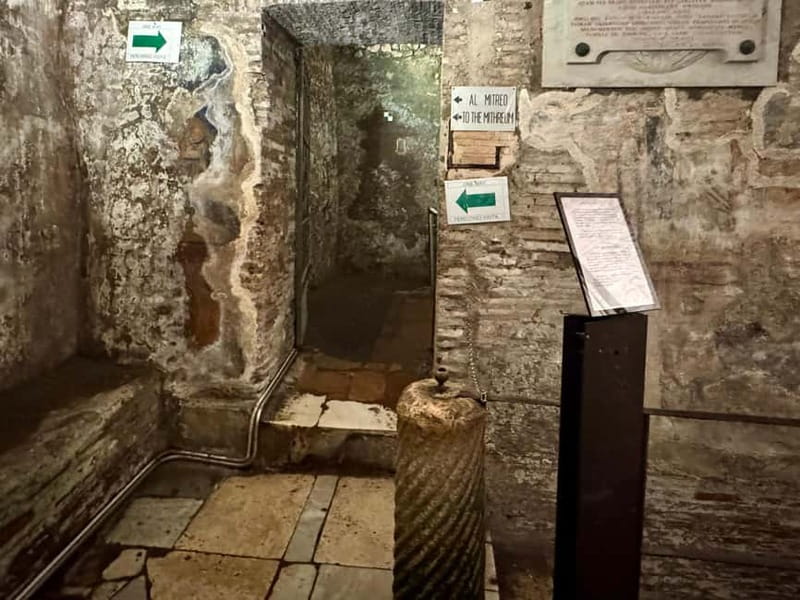
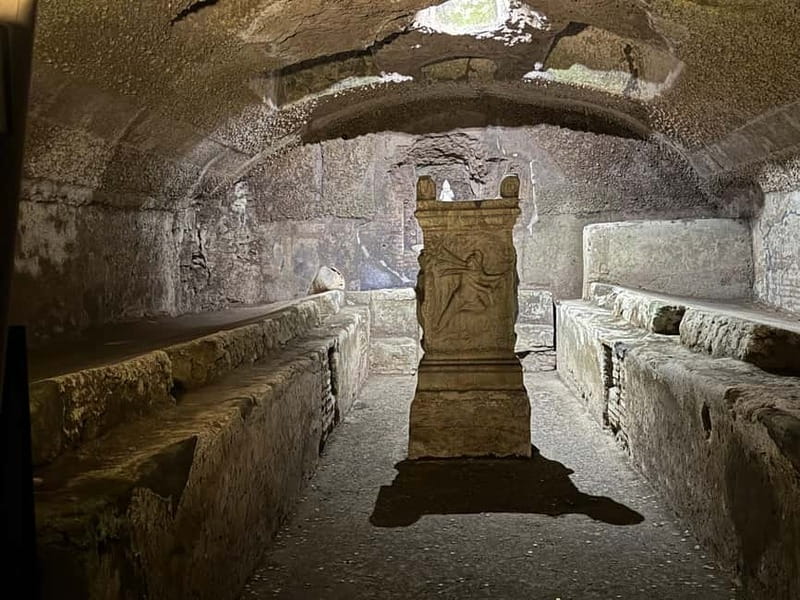
At the lowest level, you reach a 1st-century Roman house and the Mithraeum, a temple linked to the cult of Mithras. The worship of Mithras was practiced in private, often by small groups, and this underground setting gives the site an appropriately secretive feel.
The Mithraeum is the most unusual stop on the route. It represents a religious world that existed alongside early Christianity, before Christian worship became the dominant public faith of the Roman Empire. Seeing the two traditions occupy the same layered site adds depth to the visit.
The Roman house is just as important. It reminds you that ancient Rome was made from ordinary domestic spaces as much as emperors’ palaces and public monuments. Beneath the grand churches and imperial ruins, people lived, gathered, and practiced their faith in smaller rooms.
You may find the lower level darker and cooler than the streets above. Wear shoes with good grip and avoid carrying bulky luggage. Large bags are not allowed, and the stairs can be awkward if you are trying to manage extra belongings.
Private guide or audio tour?
The private guided tour is the better pick if you want the full route. It covers all three locations, includes entrance tickets, and keeps the story connected from Michelangelo to gladiators to underground religion.
The advertised live guide languages include English, Spanish, Italian, and French, while the included private guide is described as English-speaking. Check the exact language and meeting point when you book, since the starting location can vary by option.
The audio tour is a different product, not simply a cheaper version of the same full walk. It provides entry to San Clemente and access to the three underground levels, with audio in English, Italian, Spanish, French, and German. You explore on your own and do not visit the other two stops through this option.
I would choose the private tour for a first visit to Rome or for anyone who wants the archaeological connections explained as they go. I would choose the audio route if you have already seen the major sights, prefer independence, or want to spend more time listening and moving at your own speed.
One useful detail: the audio tour works through an app, so download and test it before you arrive. A recent smartphone with an updated operating system is recommended. Older devices may have trouble with compatibility or playback.
Price, walking, and practical value
At $31 per person, this is a fair price for the private option if your booking includes the guide and all entrance tickets. You receive a small, focused experience rather than a long city tour, and the route uses sites that many people skip while rushing between the Colosseum and Forum.
The value is strongest for someone who wants interpretation. The Ludus Magnus ruins are easier to appreciate with explanation, and San Clemente’s layers make more sense when someone connects the dates and religious changes.
The audio option may be better value for an independent visitor who mainly wants San Clemente. It costs less in time and gives you more control, but you give up San Pietro in Vincoli, the Ludus Magnus, and live storytelling.
The walk between stops is short, but transportation is not provided. Start with good walking shoes, allow a little time to find the meeting point, and bring identification. The tour runs in all weather, so dress for the conditions.
Cancellation is flexible up to 24 hours before the start for a full refund, and you can reserve now and pay later. Those policies are useful if your Rome schedule is still moving around.
Who should book this underground Rome experience?
I recommend it for first-time visitors who want more than the standard Colosseum route. It also suits repeat visitors who have already seen Rome’s famous squares and want a quieter, more unusual look at the city.
Art lovers will value Michelangelo’s Moses. History fans will appreciate the gladiator training complex and the movement through Roman, Christian, and medieval layers. Religious history enthusiasts will find the Mithraeum especially worthwhile.
Families can manage the route if children are comfortable with stairs and underground spaces. The experience is not suitable for wheelchair users, and anyone with limited mobility should ask about the exact stair conditions before booking.
The short duration is another plus. You can fit it into a morning or afternoon without giving up a full day. The main limitation is that the tour cannot provide a huge amount of time at every location. San Clemente deserves patience, so the audio option may appeal if you dislike being hurried.
Should you book it?
Book the private guided version if you want the complete story and the best value from the $31 price. It combines major art, gladiator archaeology, and one of Rome’s most unusual underground sites in a compact walk.
Choose the audio version if San Clemente is your only priority and you are comfortable handling an app, headphones, and your own pace. Skip the experience if stairs, uneven ground, enclosed spaces, or strict church dress rules will make the visit uncomfortable.
For most able-bodied visitors with limited time near the Colosseum, this is a smart addition. Rome’s famous ruins show you the city’s public face. San Clemente and the sites around it show what was happening below.
FAQ
How long does the experience last?
The activity lasts between one and two and a half hours, depending on the option booked and the pace of the visit.
What sites are included in the private guided tour?
The private tour includes San Pietro in Vincoli, the Ludus Magnus, and the three underground levels of the Basilica of San Clemente.
What does the audio guided option include?
The audio option includes entry to the Basilica of San Clemente and access to its three underground levels. It does not include the other two stops.
Which languages are available for the audio guide?
The audio guide is available in English, Italian, Spanish, French, and German.
Is transportation provided between the sites?
No. The sites are within walking distance of one another, and you walk between the stops.
What should I wear?
Knees and shoulders must be covered to enter the churches for both men and women. Comfortable walking shoes are recommended.
Is the tour wheelchair accessible?
No. The underground areas include stairs and uneven surfaces, and the experience is not suitable for wheelchair users. Non-folding wheelchairs, walking frames, and electric wheelchairs are not allowed.
Just added around Italy
- Private Tour to the Villa Romana del Casale and the Valley of the Temples★ 4.5 · 19 reviews
- Agrigento and Piazza Armerina: Valley of the Temples and Villa Romana del Casale★ 4.5 · 121 reviews
- Villa Romana Del Casale in Piazza Armerina and Valley Of Temples in Agrigento★ 4.5 · 38 reviews
- Padre Pio’s Shrine in San Giovanni Rotondo from Bari (Apulia)★ 5.0 · 3 reviews
- Cooking Class in a former Artist Monastery in the Heart of Monopoli★ 5.0 · 18 reviews
- Agrigento to Siracusa with Valley of Temples and Roman Villa Trip★ 5.0 · 5 reviews
- Private transportation to the Valley of the Temples + Agrigento★ 5.0 · 8 reviews
- Agrigento Valley of the Temples Archaeological Area★ 4.0 · 33 reviews
Rome Temple Tours, compared.
Pantheon Elite Guided Tour – Rome’s Iconic Ancient Temple
Read our review →
Rome’s Iconic Temple: Pantheon Audio Guided Tour with Fast Access
Read our review →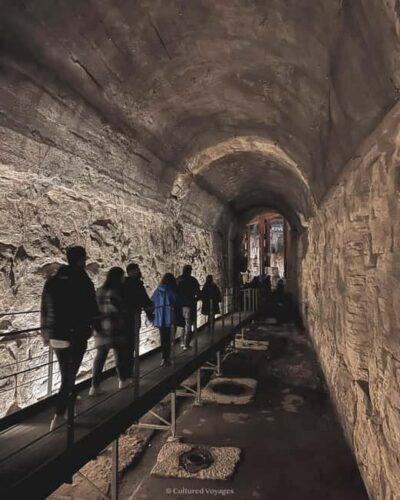
Colosseum Special Access Tour, with Ancient Temples & Tombs
Read our review →
Walking Guided Tour and Rome’s Iconic Temple Pantheon Entrance
Read our review →
Rome’s Iconic Ancient Temple: Pantheon Fast Track Entry Tickets
Read our review →
Tour of St. Clement’s Basilica Underground Temples
Read our review →
Pantheon: The Iconic Ancient Roman Temple – Semi-Private Tour
Read our review →
Browse the lists this tour appears in