
Review · ASWAN
Private Tour: Kalabsha Temple on Lake Nasser
Ancient stone meets a modern lake here. This three-hour private tour from Aswan takes you to Kalabsha Temple, a Nubian monument moved stone by stone when the Aswan High Dam threatened to flood it. I like the personal attention of a private Egyptologist and the chance to see a quieter site than the major stops around Aswan. I also like the mix of Egyptian, Roman, and early Christian carvings.
The main thing to consider is the temple’s condition. Kalabsha has an impressive pylon, columns, halls, and reliefs, but parts of the façade were never finished. One recent French-speaking guest also reported that hotel pickup did not happen as expected, so I would confirm the pickup details with the operator before the morning of the tour.
Key points at a glance
- A temple saved from the rising waters: Kalabsha was dismantled and rebuilt in the 1960s after the Aswan High Dam created Lake Nasser.
- Roman-era Nubia in stone: The temple was largely completed under Emperor Octavius Augustus around 30 BC and dedicated to the Nubian god Mandulis.
- Three faiths in one monument: Egyptian and Roman reliefs share space with Coptic crosses and an image of St. George.
- Private guiding makes a difference: Your Egyptologist can explain symbols, construction, and relocation without a large group slowing the visit.
- A peaceful Lake Nasser setting: The temple sits beside the water, with desert and palm views during the drive and at the site.
- Good value for a short outing: At $67.86 per person, the tour includes private transport, a guide, hotel pickup and drop-off, though landing and facility fees are extra.
Why Kalabsha deserves a place in your Aswan plans
Aswan is best known for Philae Temple, the Unfinished Obelisk, and boat trips on the Nile. Kalabsha is less familiar, which is part of its appeal. You get a major stone temple without the same level of attention found at Egypt’s headline sites.
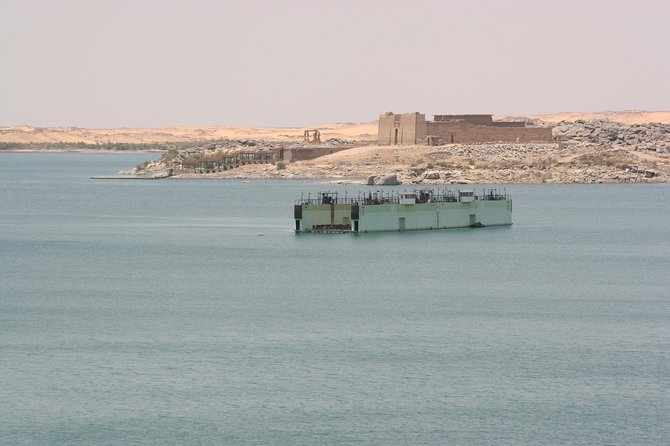
The setting also changes the feel of the visit. Kalabsha is on the shore of Lake Nasser, not along the older Nile riverfront in central Aswan. You travel south through palm groves and dry desert scenery, then arrive at a broad body of water formed by one of Egypt’s biggest engineering projects.
I find the temple especially useful for understanding how Nubia changed over time. It was built under Roman rule, honored a Nubian deity, carried Egyptian religious images, and later served as a Christian church. That is a lot of history in one compact site.
The temple is not the most polished or complete monument in Egypt. The façade is largely undecorated, and some work was left unfinished. Still, that unfinished quality helps you see the building as a working project rather than a perfectly preserved stage set.
More Private Temple Tours in Aswan
- Private Day Trip To Kom Ombo And Edfu Temples From Aswan
★ 4.5 · 41 reviews - Private Day Tour to Abu Simbel Temples from Aswan – Private Tour
★ 5.0 · 35 reviews - Aswan: Private Tour to Philae Temple and Nubian Village By Boat & Entrance Fees
★ 5.0 · 34 reviews
The 9 a.m. drive from Aswan to Lake Nasser
Your morning begins with pickup at your Aswan hotel, scheduled for 9 a.m. You ride in a private, air-conditioned minivan with your guide. For a three-hour outing, private transport matters. You do not have to wait for a large group, and your guide can adjust the pace to your interests.
The route gives you a quick change of scenery. Palm groves give way to desert views as you head toward Lake Nasser. The drive is not presented as a separate sightseeing stop, but it helps explain why Kalabsha feels removed from the city.
Use this time to ask your guide about the Aswan High Dam and the rescue of Nubian monuments. Kalabsha was one of 18 monuments relocated in the 1960s. Workers took the temple apart and rebuilt it in its current position before the waters could cover the original site.
That rescue effort is central to the visit. You are not simply seeing an old temple beside a lake. You are seeing an old temple in a new setting, preserved through a huge international conservation effort.
One practical point deserves attention. Hotel pickup is advertised, but a French-language guest reported that it did not take place as expected and that the agency would not provide it. I would confirm the exact pickup point, time, and vehicle before setting out. The tour description also refers to sailing by motorboat around the island, so ask how that boat portion fits into your planned schedule.
The great pylon and the open court
Kalabsha begins with its pylon, the broad gateway that gives an Egyptian temple its strong first impression. The façade here is impressive in scale, though much of it is undecorated. Your guide can point out what was completed, what was planned, and how the temple’s Roman date affects its design.
The temple was largely completed under Octavius Augustus around 30 BC. It was dedicated to Mandulis, a Nubian sun god. That detail matters because Kalabsha is not simply a Roman building dropped into Egypt. It reflects Nubian religious life under Roman control.
After passing the entrance, you walk into the court. The open space gives you room to look back at the pylon and forward toward the inner rooms. The private format is useful here. You can stop to study a carving, ask about a damaged section, or move ahead without trying to keep pace with a bus group.
You will also see columns and the hypostyle hall. These spaces are more enclosed and carry a different mood from the bright court. Look closely at the column decoration and wall scenes. Some images follow older Egyptian traditions, while others show the changing political world in which the temple was built.
The tour is a good fit if you enjoy looking at details rather than simply collecting photographs. The guide’s explanations help connect the symbols with the building’s purpose.
Reliefs that link Egypt, Rome, and Christianity
The carvings are the heart of the visit. One important relief shows Augustus making an offering to Mandulis. It gives you a direct visual link between the Roman emperor and the local Nubian god.
You will also see Egyptian and Roman motifs across the temple. This mixture is not a flaw or a confusing accident. It shows how religious buildings continued to use established Egyptian forms even during the Roman period.
The later Christian use of the building adds another layer. Coptic crosses and an image of St. George remain on the walls. These marks tell you that the temple was reused as a church after its original religious purpose faded.
I like sites where later history has not been scrubbed away. At Kalabsha, the Christian carvings do not erase the older temple. They sit alongside it, allowing you to read the building as a record of changing belief.
You may also see an inscription in Meroitic, an ancient language that remains difficult for modern Egyptologists to fully understand. That small detail gives the temple a sense of mystery without needing dramatic storytelling. Even after years of study, some of its words remain beyond easy translation.
Ask your guide to show you the Christian marks and the Meroitic inscription directly. Without help, you could easily walk past them.
More Private Temple Tours in Egypt
- Aswan : Private Tour to Unfinished Obelisk, High Dam and Philae Temple by BOAT
★ 4.5 · 22 reviews - Aswan Philae Temple, Obelisk, and High Dam Private Tour
★ 4.5 · 17 reviews - Private Tour: Philae Temple, Aswan High Dam and Unfinished Obelisk
★ 4.5 · 11 reviews - Private Tour to Abu Simbel Temple From Aswan
★ 5.0 · 10 reviews
The sanctuary and the unfinished details
The route continues through the sanctuary, the most sacred part of the temple. Your guide explains how the inner rooms related to worship and to the deity Mandulis.
This is a good place to slow down. The sanctuary is not as open as the court, and the change in space helps you understand the temple’s movement from public areas toward private religious rooms. You can also compare the finished carvings with plainer or incomplete surfaces nearby.
Kalabsha’s unfinished sections may disappoint anyone expecting every wall to be covered. I see them differently. They show that construction and decoration were separate stages, and that a building could be used or considered important even when every planned detail was not complete.
The guide’s role is especially valuable inside the halls and sanctuary. A private Egyptologist can explain where to look and why certain scenes matter. With a larger group, these details can get lost in the general tour talk.
The advertised visit includes the court, halls, hypostyle hall, columns, sanctuary, and reliefs. Plan on walking through several connected areas rather than spending the whole time in one open courtyard.
Lake Nasser views and the return to Aswan
After the temple, you have time to look toward Lake Nasser from the water’s edge. The view is part of what makes Kalabsha different from temples surrounded by shops, roads, or dense city activity.
The lake also brings the relocation story into view. The monument was saved from flooding, but it now sits beside the water that caused the danger. That contrast is hard to miss.
The tour information includes motorboat sailing around the island. It also refers to other temples on the island in the description of the overall outing. Because the main itinerary focuses on Kalabsha, I would confirm exactly which boat movements and additional monuments are included on your date. Landing and facility fees are not included, so ask about those costs before departure.
After the lake stop, you return to Aswan by private minivan for hotel drop-off. The full outing lasts about three hours, making it easy to fit into a morning or pair with another Aswan plan later in the day.
What the $67.86 price gets you
At $67.86 per person, this tour is not the cheapest way to see a temple, but the price is reasonable if you value privacy and a guide who can focus on your group. The package includes private air-conditioned transportation, hotel pickup and drop-off, and a qualified Egyptologist guide.
The value improves for two or more people sharing the private vehicle. Group discounts are offered, so check the final rate for your party rather than judging the price only per person.
The main missing costs are landing and facility fees. These are not included in the listed price. A supplement of 1,000 Egyptian pounds applies to guides in languages other than English, so English is the economical choice. French is available at an added cost, and one French-speaking guest praised the guide’s excellent command of the language.
I would ask three questions before booking:
- Are pickup and drop-off confirmed at my hotel?
- Are the motorboat and any additional island temples included?
- What landing or facility fees will I pay locally?
Those questions prevent the most likely surprises.
Who will enjoy this private tour most
I would choose Kalabsha for someone who has already seen the major Aswan monuments and wants a less familiar site. It is also a smart choice if you like Roman-era Egypt, Nubian culture, temple relocation projects, or religious buildings reused over time.
The tour suits couples, families, and small groups who want to ask plenty of questions. A private guide is useful if one person in your group cares about inscriptions while another wants more attention on architecture or photography.
It may be less satisfying if you want a huge, perfectly decorated temple with every surface intact. Kalabsha has unfinished areas, and the temple is described as one of the lesser-known sites in the region. Its appeal comes from the setting, the rescue story, and the layers of religious use.
Most travelers can participate, and this is a private activity for your group only. The short duration also makes it manageable if you have limited time in Aswan.
Booking and cancellation details
Confirmation is provided at booking, and the tour begins at 9 a.m. Mobile tickets are available. Free cancellation applies if you cancel at least 24 hours before the local start time.
Cancellations made less than 24 hours before departure are not refunded, and changes inside that same period are not accepted. Keep the local time in mind if your plans change.
FAQ
How long does the Kalabsha Temple tour last?
The tour lasts about three hours, including transport from Aswan, the temple visit, time beside Lake Nasser, and the return to your hotel.
What time does the tour start?
The scheduled start time is 9 a.m.
Is hotel pickup included?
Hotel pickup and drop-off are listed as included. Because one guest reported a pickup problem, confirm your hotel, meeting point, and pickup time with the provider in advance.
Is the tour private?
Yes. Only your group participates, and the tour includes a private air-conditioned minivan and a private Egyptologist guide.
What languages are available?
English guiding is available. A supplement of 1,000 Egyptian pounds applies to all languages other than English.
Is the motorboat included?
The tour information includes sailing by motorboat around the island. Since the main visit centers on Kalabsha Temple, confirm the exact boat arrangements and any additional island stops before booking.
Are extra fees included in the price?
Landing and facility fees are not included. Ask the provider for the current amount before the tour.
Can I cancel for a full refund?
Yes, if you cancel at least 24 hours before the experience begins. Cancellations or changes made less than 24 hours before the start time are not accepted for a refund.
Should you book Kalabsha Temple?
Book it if you want a quiet, private look at Roman-era Nubia and enjoy monuments with more than one chapter to tell. The combination of Mandulis worship, Roman rule, Christian reuse, a mysterious Meroitic inscription, and relocation beside Lake Nasser gives the visit real substance.
I would be less quick to book if your schedule is packed with Egypt’s biggest temples or if you need every detail included in one fixed price. Confirm the pickup, boat arrangements, and local fees first.
For most history-minded visitors with a free Aswan morning, Kalabsha is a good-value addition. It will not replace Abu Simbel or Philae, but it gives you a quieter and more layered view of Nubia, with a private guide to help you see what the stones are saying.
Just added around Aswan
- Philae Temple and Aswan High-Dam Half-day tour★ 5.0 · 49 reviews
- Sound and Light show at Philae Temple in Aswan★ 5.0 · 5 reviews
- Aswan Philae Temple, Obelisk, and High Dam Private Tour★ 4.5 · 17 reviews
- Abu Simbel Temples from Aswan★ 4.5 · 10 reviews
- Tour to Abu Simbel Temples from Aswan★ 4.5 · 7 reviews
- Visit Abu Simbel temple from Aswan by private A/C vehicle★ 5.0 · 4 reviews
- Temple of Edfu★ 4.0 · 11 reviews
- Tour To Abu Simbel Temples By Road★ 5.0 · 4 reviews
Private Temple Tours, compared.

Waterfalls, Water Temple & Rice Terraces Private Tour
Read our review →
Montserrat Monastery Small Group or Private Tour Hotel pick-up
Read our review →
Full-Day Angkor Wat Sunrise Private Tour with Guide from Siem Reap
Read our review →
Chiang Rai Temples: Private Tour from Chiang Mai
Read our review →
Private Tour: Teotihuacan and Guadalupe Shrine
Read our review →
Grand Palace, Wat Pho, and Wat Arun Private Tour
Read our review →
Ephesus and Temple of Artemis Private Tour from Kusadasi Port
Read our review →
Browse the lists this tour appears in