
Review · MADRID
Escorial Monastery and the Valley of the Fallen from Madrid
Two powerful sites sit just outside Madrid. This half-day excursion combines the vast El Escorial monastery with the Valley of the Fallen, giving you royal tombs, painted ceilings, a basilica carved into granite, and a sharp look at Spain’s past. I especially like the comfortable coach ride from central Madrid and the chance to see two major monuments without arranging separate transport.
I also like the guided access to El Escorial, where you see the basilica, royal pantheon, library, palace rooms, and unusual architectural displays in one visit. The main drawback is pace: the Valley of the Fallen can feel rushed, and some departures may visit only El Escorial, so you must check exactly what your chosen date includes before paying.
This is a useful choice if you have limited time in Madrid and want a guided introduction rather than a full day spent at one site. It is less suitable if you need a slow visit, dislike stairs, or expect an English-only tour with no Spanish commentary.
Key Points to Know Before Booking
- El Escorial takes up most of the visit: You get about two and a half hours at the monastery, including its royal tombs, basilica, library, and palace rooms.
- The Valley of the Fallen is not guaranteed on every departure: Check the selected option and date carefully, especially around Tuesday and Thursday departures.
- The tour is bilingual: The regular service operates in English and Spanish, which can mean longer explanations and occasional difficulty following the guide.
- Expect plenty of walking and stairs: Full access is not guaranteed, and the operator does not recommend the tour for people with walking difficulties.
- The coach ride is simple and convenient: You leave from central Madrid at 8:30 a.m. and return to Plaza de Oriente.
- The price is fair only if both sites are included: At $79.30, transport, admissions, and a guide make sense, but the value drops if you receive only the monastery visit.
Leaving Madrid for San Lorenzo de El Escorial

The day begins at the Julià Travel office on Calle de San Nicolás, near the center of Madrid. You are asked to arrive 15 minutes early, then board an air-conditioned coach for the roughly 28-mile, or 45-kilometer, journey northwest.
The drive matters because El Escorial is not a quick Metro ride from central Madrid. You could arrange transport yourself, but the coach removes the need to coordinate trains, buses, tickets, and the final connection to the monument. The countryside outside the city also gives the guide room to explain why Philip II commissioned such an imposing complex in the 16th century.
The scheduled departure is 8:30 a.m., with the full outing lasting about five and a half hours when both stops operate. You return to Plaza de Oriente, a handy end point near the Royal Palace and central Madrid. Hotel pickup and drop-off are offered only with the private tour option, so the standard group trip requires you to reach the meeting point yourself.
The vehicle is one of the better practical features. It is air-conditioned, and a radio-guide system is provided. That said, the value of the audio equipment depends on the guide speaking clearly and keeping the group within range. A few people have found guides difficult to understand or too quick on the walk, so stay close and tell the guide promptly if you are losing the explanation.
A few more temple visits around Spain worth a look
- Montserrat Monastery Half Day Experience from Barcelona
★ 5.0 · 6,014 reviews - Montserrat Monastery Small Group or Private Tour Hotel pick-up
★ 5.0 · 5,144 reviews - Escorial Monastery and the Valley of the Fallen Tour from Madrid
★ 5.0 · 2,494 reviews
Entering the UNESCO-Listed El Escorial
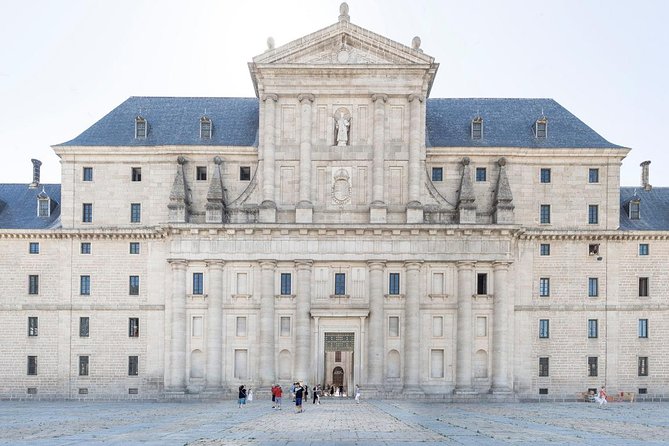
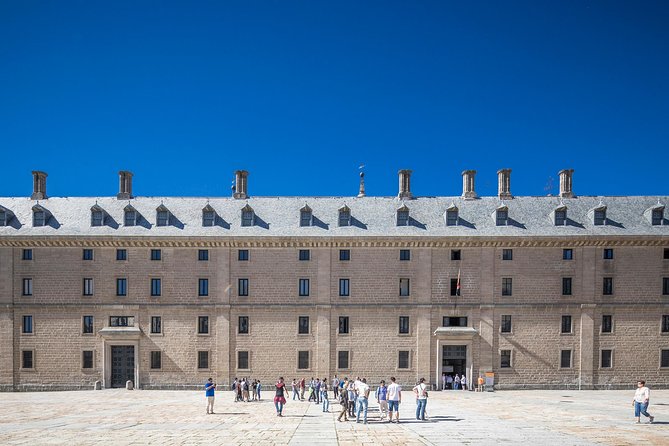
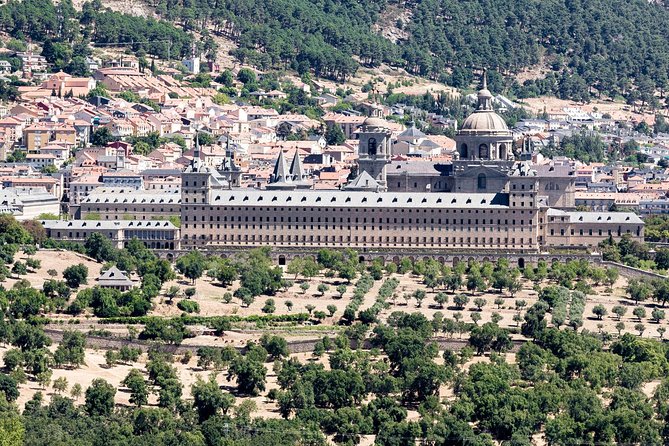
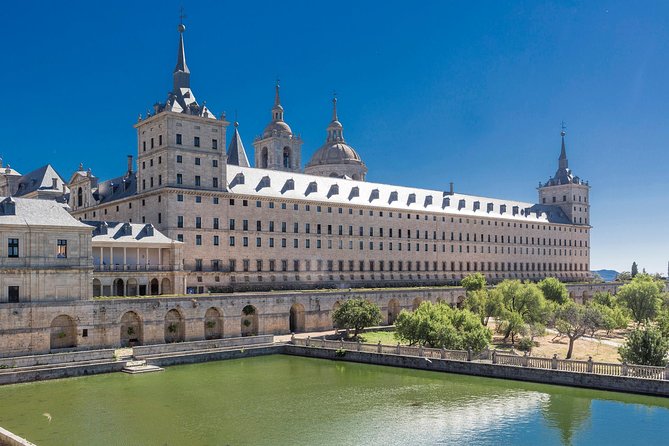
El Escorial is the main event. The complex was built in the 16th century and served as a monastery, royal residence, burial place, basilica, and center of learning. Its ordered Renaissance design reflects the political and religious power of Spain during the Habsburg period.
Your guided visit lasts about two hours and thirty minutes, with admission included. The route covers the major areas rather than offering free time to wander at your own speed. That tradeoff is important. You see a great deal in one visit, but you may not have enough time to linger before every painting, ceiling, or carved detail.
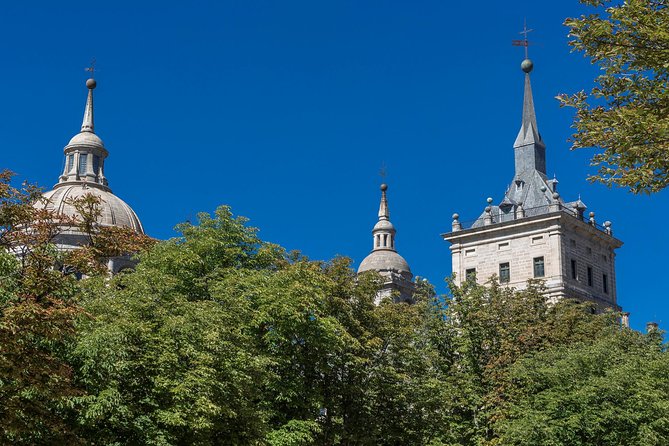
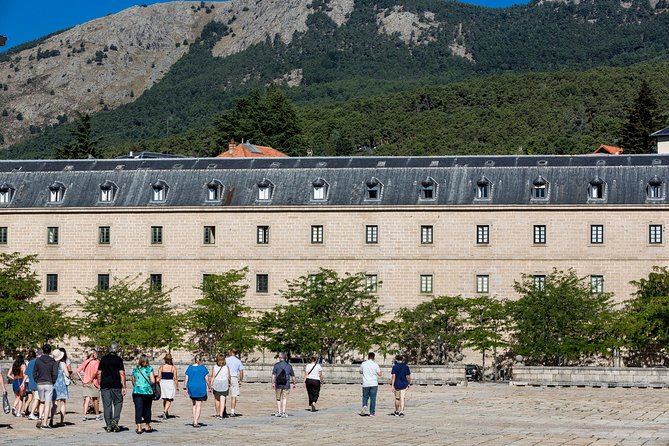
The building’s symmetry is striking from the start. Inside, the route can include the Habsburg Palace, Chapter House, Basilica, and library. The basilica’s Baroque dome and religious relics give the visit its grand public face, while the royal rooms and tombs make the building feel more personal and political.
The Pantheon of Kings is one of the most memorable stops. The marble tombs include Charles V and other Spanish monarchs, arranged in a solemn chamber that makes the monastery’s role as a royal burial place clear. Isabella of Portugal is also linked to the royal tombs and the monastery’s founding story.
The Architects Room offers a less obvious pleasure. Instead of more royal decoration, you see construction equipment and material connected with the building process. It helps you picture the practical labor behind a project often treated only as a symbol of monarchy.
The Weapons Room adds another change of mood, while the library brings color and intellectual life through its frescoes. These rooms are why I think a guide adds real value at El Escorial. Without context, you might admire a ceiling or a corridor but miss how the complex joined religious devotion, royal power, military history, and scholarship.
Still, the tour has limits. A group of up to 30 people per guide can feel crowded in narrow rooms, especially when another group arrives at the same time. Some people have found the pace too fast to appreciate the artwork. If you want quiet time with each fresco, a self-guided or private visit may suit you better.
The Valley of the Fallen and Its Giant Cross
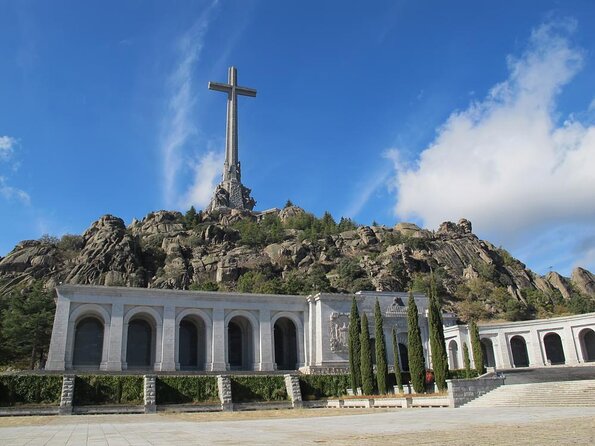
If your selected departure includes the second stop, the coach makes the short journey to the Valley of the Fallen, about nine kilometers from El Escorial in the Sierra de Guadarrama. You can spot the enormous cross from a distance before reaching the monument.
The site commemorates those who died in the Spanish Civil War, but it is also bound up with the politics and memory of Franco’s Spain. That makes it a solemn and complicated place, not simply another grand church on a sightseeing route. The guide explains the origins of the monument outside, giving you useful context before you enter.
The basilica is carved into the mountainside, with a vast underground church and a vaulted crypt decorated with sculpted angels. The scale is difficult to grasp from photographs. Outside, the arches offer views across the surrounding countryside, while the granite cross gives the site its unmistakable visual identity.
There is an important limitation here. Due to site regulations, the guide cannot give explanations inside the basilica. The information is delivered outside, and you then visit the interior on your own. That arrangement can work well if you listen carefully before entering, but it means you should not expect a continuous guided commentary inside the church.
Time is the bigger concern. The stop is scheduled for about one hour, yet some departures have allowed only around 25 to 30 minutes inside the site because of delays or a service. That is enough for a quick look, but not enough to study the crypt, take photographs, and absorb the setting without watching the clock.
The Valley of the Fallen may also be absent from certain departures. Specific feedback points to Tuesday and Thursday as days when the tour does not visit the site, even though you may still see the cross from a distance during the journey. This is the most important booking warning: do not rely on the broad tour name alone. Confirm that your chosen date and option include entry to the Valley and its basilica.
The English and Spanish Tour Question
The regular tour is bilingual in English and Spanish. That detail deserves more attention than it usually gets because it affects the entire experience.
A strong guide can handle both languages well, and guides such as Jorge, Susana, María, and Susanna have received warm praise for their explanations, organization, and care with the group. Jorge, in particular, has been singled out for sharing useful historical facts, while María has been praised for clear English.
But the language balance can vary by departure. Some English speakers have found the Spanish explanations longer, with brief English sections or accents that made the commentary hard to follow. Others have found the guide perfectly helpful and willing to repeat information. You should treat this as a bilingual group tour, not as a guaranteed English-only service.
The radio-guide system helps, but it cannot fix a guide who walks too fast, uses unfamiliar Spanish names, or speaks from too far away. Keep your receiver working, stay near the guide, and ask for clarification when needed. If detailed English commentary is central to your day, a private tour or a clearly English-only option may be worth the extra cost.
Same place, a different morning at the gates:
- Montserrat Museum and Monastery Entry Ticket
★ 4.5 · 1,740 reviews - Montserrat Small Group: Monastery, Black Madonna & Natural Park
★ 5.0 · 1,690 reviews - From Madrid: Escorial Monastery and the Valley of the Fallen
★ 4.7 · 1,434 reviews - Madrid: Flamenco Show at Tablao Sala Temple with Drink
★ 4.8 · 1,206 reviews
Walking, Stairs, and the Real Pace
The tour description is honest about walking, but it is easy to underestimate what that means. El Escorial is large, and the interior has many stairs. You move through halls, religious rooms, palace areas, and underground or enclosed spaces rather than simply viewing the complex from a courtyard.
The operator does not recommend this outing for people with walking difficulties or reduced mobility. Full accessibility cannot be guaranteed because of the building’s design. Wear comfortable shoes and suitable clothing, and prepare for a brisk pace between stops.
The guide generally keeps the group together, but a party of up to 30 people can stretch out on stairs and corridors. One useful lesson from the feedback is that slower walkers should not be shy about saying so early. The best guides make an effort to keep everyone accounted for, but the schedule leaves limited room for repeated delays.
Weather also affects the day. Cold fog can hide views around the Valley of the Fallen, while hot weather makes the lack of free time for water or shade more noticeable. Bring water with you, since lunch is not included and food stops are not part of the scheduled program.
Does $79.30 Offer Good Value?
At $79.30 per person, the tour includes the air-conditioned coach, a local guide, the radio system, entry to El Escorial, and admission to the Valley of the Fallen and basilica when that option operates. For a visitor who wants both sites in one morning, that is a reasonable package.
The value is strongest when you care about convenience. You avoid working out the transport to two monuments, and you receive historical context as you walk through rooms that would otherwise be easy to misunderstand. Group discounts may also help lower the cost for larger parties.
The value weakens in three situations. First, if the Valley is not included on your date, the price can feel high for a short guided visit to El Escorial. Second, if the bilingual commentary is difficult to follow, you are paying for information you may not fully receive. Third, if you want time for art, photographs, or quiet reflection, the fixed schedule may feel restrictive.
There is no lunch included, so plan to eat afterward in Madrid or carry a small snack if permitted during the coach journey. The return to Plaza de Oriente around early afternoon leaves time for a late lunch and another Madrid sight, provided the tour runs on schedule.
Who Should Book This Morning Trip?
I would recommend it to first-time visitors who want a broad introduction to El Escorial and the Valley of the Fallen without renting a car. It also suits people who enjoy guided history, prefer organized transport, and can manage a steady walking pace.
It is a good fit for anyone fascinated by Spanish monarchy, Habsburg power, religious architecture, and the difficult memory of the Civil War. The two sites also contrast well: El Escorial presents royal and religious authority, while the Valley of the Fallen carries a more somber political weight.
I would hesitate if you are an older visitor with limited stamina, use a mobility aid, or need guaranteed accessibility. I would also hesitate if you want a purely English tour, lots of independent time, or a leisurely photography day.
Before you confirm, check four details: the exact date, whether the Valley is included, the bilingual format, and the meeting point. Arrive early at Calle de San Nicolás, wear shoes suited to stairs, and bring water. Those small preparations address most of the practical complaints connected with this outing.
Should You Book El Escorial and the Valley of the Fallen?
Book it if you want efficient transport and a guided look at two major sites outside Madrid, and you accept a bilingual group format with a brisk schedule. El Escorial alone is worth seeing, and the Valley of the Fallen adds a powerful, unusual stop when it is operating.
Do not book without checking the date-specific inclusions. The biggest risk is expecting both monuments and discovering that your departure visits only El Escorial. If the Valley is essential to your plans, confirm it in writing before the cancellation deadline, which is 24 hours before departure for a full refund.
FAQ
Where does the tour start and finish?
The standard tour starts at the Julià Travel office at Calle de San Nicolás, 15, in central Madrid, at 8:30 a.m. It ends at Plaza de Oriente. Hotel pickup and drop-off are available only with the private tour option.
Is the tour offered in English?
The regular tour operates bilingually in English and Spanish. The balance between the two languages can vary by departure, so it should not be treated as an English-only tour.
Is the Valley of the Fallen included on every date?
No. The Valley may not be visited on certain departures, including dates identified as Tuesday and Thursday. Check the exact option and date before booking. On some departures, you may see the cross from a distance even when you do not enter the site.
How long do you spend at each monument?
The El Escorial visit lasts about two hours and thirty minutes. The Valley of the Fallen stop is scheduled for about one hour, although the time inside can be shorter if the schedule changes or a service is taking place.
Is lunch included?
No. Lunch is not included in the tour price.
Is the tour suitable for people with walking difficulties?
The tour is not recommended for people with walking difficulties or reduced mobility. El Escorial has many stairs, and full accessibility cannot be guaranteed because of the monument’s architecture.
Just added around Spain
- Montserrat Monastery Horse Riding & Walk – Small Group (Max 8)★ 5.0 · 45 reviews
- Montserrat Nature Walk, Monastery and Museum from Barcelona★ 5.0 · 58 reviews
- Montserrat & beyond private from Barcelona with different options★ 5.0 · 32 reviews
- Transfer to Montserrat Monastery from Barcelona★ 4.5 · 94 reviews
- Private Montserrat & Hot-Air Balloon Ride with Monastery visit★ 4.5 · 5 reviews
- Montserrat Tour with Cogwheel Train, Monastery & Black Madonna★ 4.0 · 10 reviews
- Montserrat Monastery and Mountain Half Day Hiking from Barcelona★ 4.5 · 6 reviews
- Montserrat Horseback Riding & Monastery – Small Group (Max 8)★ 5.0 · 45 reviews
Madrid Temple Tours, compared.
Escorial Monastery and the Valley of the Fallen Tour from Madrid
Read our review →
Flamenco Show at Tablao Sala Temple with Drink
Read our review →
Entrance to the Flamenco Temple Room in Madrid with Tapas Option
Read our review →
Madrid Must-see with Atardeder at the Debod Temple
Read our review →
Combined admission to San Antonio de los Alemanes and the Monastery of San Plácido
Read our review →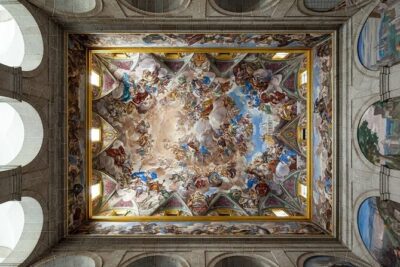
San Lorenzo de El Escorial Monastery Private Tour
Read our review →
Royal Monastery of the Barefoot nuns: Guided Tour + Tickets
Read our review →Browse the lists this tour appears in