
Review · CAMBODIA
Full-day: Wat Banan. Old bamboo train. Bat Cave. Killing cave
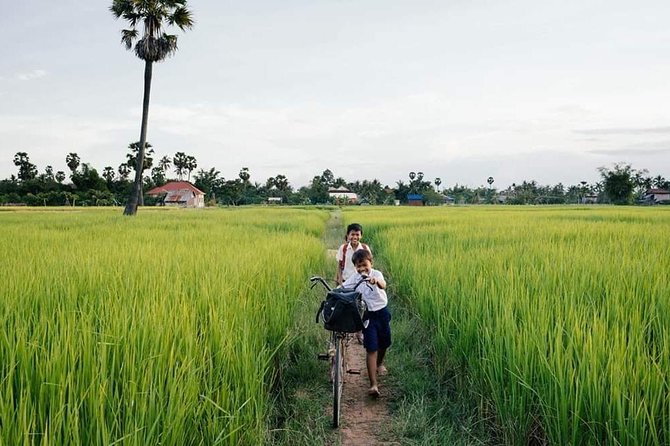
Battambang rewards slow travel. This full-day outing combines cycling through villages, a ride on the old bamboo train, Wat Banan, and Phnom Sampov’s caves in one packed route. I like the chance to see ordinary rural life between the major sights, and I like that the tour keeps its group small, with no more than 10 people.
The guide is another strong point. Mr Lychee is praised for his English, local knowledge, and warm manner, while Sambath and the Chemin Cycling team also receive strong praise. The main consideration is stamina: one account puts the cycling distance at about 45 kilometers, and the day includes a temple climb, long sightseeing stops, and a serious historical visit at the Killing Cave.
What makes this Battambang day special
- About 45 kilometers of mostly gentle cycling: The route is described as manageable even for a less confident cyclist because the pace is relaxed and the countryside is flat.
- The original-style bamboo train: You ride a simple bamboo platform on rails for about an hour, a memorable piece of Battambang’s transport past.
- Wat Banan’s old stairway: Reaching the temple means climbing an ancient staircase, but the effort adds to the sense of place.
- Local food stops: You may see bamboo sticky rice being prepared, taste dried banana and fried spring rolls, and eat lunch at a typical Cambodian restaurant.
- A guide who adds meaning: Mr Lychee and Sambath are praised for explaining Cambodian food, religion, village life, and the country’s difficult past.
- A full rural-to-historical route: The day moves from city buildings and bridges to villages, temples, rice fields, bat caves, and the Killing Cave.
Starting in Battambang with a local introduction
The day begins in Battambang, Cambodia’s relaxed second city, with a look at a colonial building or the provincial hall. This is not a long architectural tour, but it gives you a quick sense of the city before the countryside takes over.
You also stop at the Tadam Bong Kro Aung statue and hear the story connected with it. That small detail matters. Instead of racing straight to the famous sights, the tour begins by giving you local reference points and a little civic history.
Your guide then helps you get set up with a mountain bike and helmet. The equipment is described as good quality, and a helmet is included. Hotel pickup and drop-off are also part of the package, with transportation by traditional tuk-tuk. That is useful in Battambang, where the day begins and ends in town but the main sights are spread across the surrounding area.
The tour is described as private for your own group, even though the maximum group size is 10. That wording suggests a more personal outing than a large bus trip, but you should confirm the exact group arrangement when booking if that distinction matters to you.
A few more temple visits around Cambodia worth a look
- Grand Tour-Ek Phnom. Baset. Bamboo Train. Wat Banan. Phnom Sampov
★ 5.0 · 20 reviews - Full-day: Original bamboo train, Wat Banan, Phnom Sampov
★ 5.0 · 15 reviews - Bamboo train. Phnom Sampove cave. Bat cave and Banan Temple
★ 4.9 · 12 reviews
Crossing the suspension bridge and entering village life
One of the early stops is a suspension bridge over the Sangke River. You have time to take photos before crossing, then continue toward Kampon Pile Pagoda.
This section is less about checking off a single major monument and more about seeing how the countryside connects. At the pagoda, the guide explains aspects of Buddhism, giving you a useful frame for later temple visits. Cambodia’s Buddhist traditions are part of daily life, so even a short explanation can make the shrines, statues, and temple grounds easier to understand.
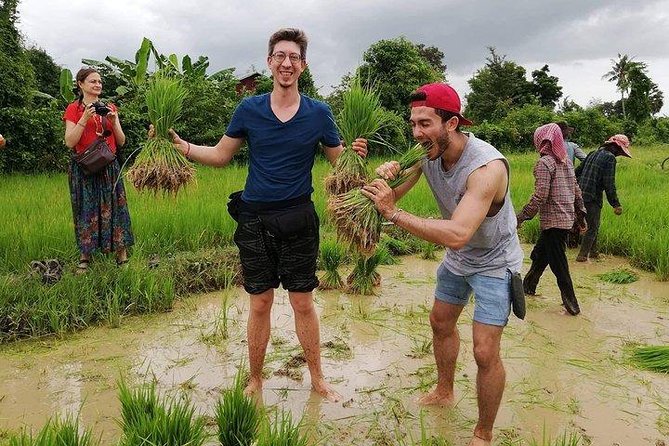
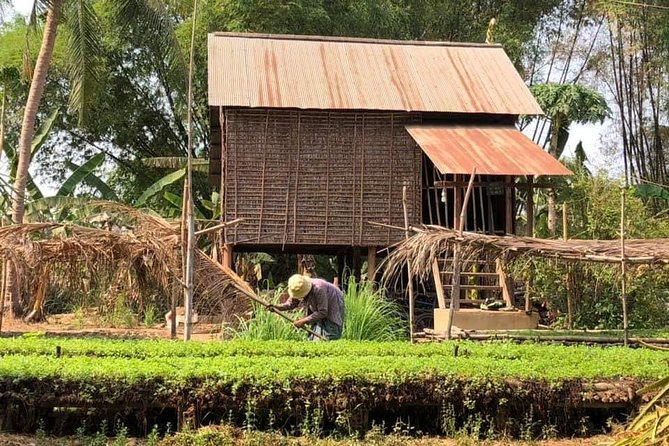
The route also passes through Cham and Javanese villages. This is one of the day’s strongest features because the experience is not limited to Khmer temple culture. You learn about different communities, their customs, and their religious life as you cycle through the villages.
The supplied tour details mention local snacks, fishing with people at Tonle Sap Lake, a fish market, rice-paper production, and Khmer rice whiskey making. Not every one of these activities is clearly assigned to a specific stop, so treat them as possible parts of the wider route rather than guaranteed timed visits. Still, they show the sort of local encounters this tour is designed to include.
Riding Battambang’s bamboo train
The bamboo train is the day’s most playful stop. At Ou Srauo Laou, you board a simple bamboo platform and ride the rails for about an hour. The platform is driven to another village, where you can continue for a longer stretch on the original-style train.
This is not a polished theme-park attraction. Its appeal comes from the stripped-down design and the unusual feeling of sitting low over the tracks as the countryside passes by. It is a very different experience from a standard train ride, and the simplicity is exactly the point.
You should expect the bamboo train ticket to cost extra. The tour description lists the ride as not included, while the price section also refers to an additional $5 per person for fees and taxes. Because those cost notes are not perfectly consistent, ask the operator to confirm the final amount before departure.
The ride also has a practical limitation: the bamboo train is a novelty experience rather than a long scenic railway journey. You get the memory and the local character, not a full day on the rails. Combined with the bicycle route, though, it breaks up the physical effort nicely.
Lunch, snacks, and Cambodian food traditions
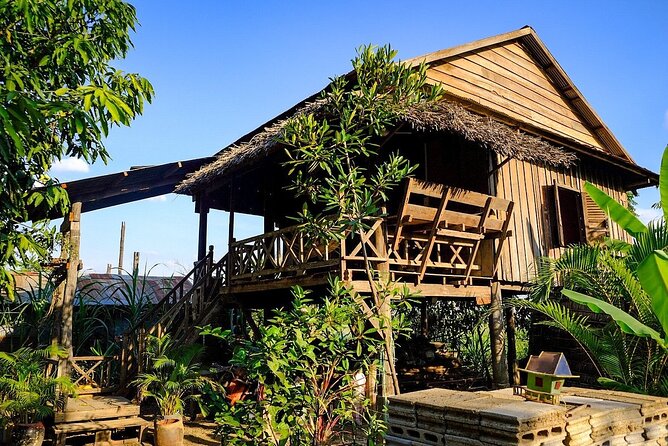
Food is woven through the day rather than treated as an afterthought. Lunch is provided at a typical Cambodian restaurant, and the tour includes local tastes such as dried banana and fried spring rolls.
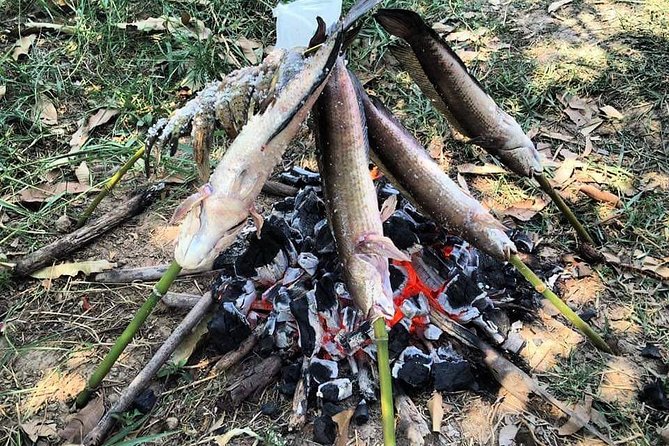
You may also see bamboo sticky rice being prepared. This is a particularly good stop for anyone interested in how food is made, since the bamboo container is part of the cooking method as well as the presentation. The route may also include a look at Khmer rice whiskey production, a small-scale tradition that gives you a glimpse of rural household industry.
The details of lunch are not specified, so you should not expect a fixed menu or restaurant name in advance. If you have food restrictions, tell the operator when booking. Bottled mineral water and a cold towel are included, which is welcome after cycling in Cambodia’s heat.
I especially like the food element because it gives the day texture. You are not just looking at temples from the roadside. You are stopping to see what people make, eat, sell, and use in everyday life.
More Full-Day Tours in Cambodia:
- Siem Reap: Full-Day Angkor Wat Guided Tour with Sunset
★ 4.9 · 3,803 reviews - Full-Day Angkor Wat Sunrise Private Tour with Guide from Siem Reap
★ 5.0 · 2,920 reviews - Siem Reap: Angkor Wat Sunrise and Full-Day Sightseeing Tour
★ 4.9 · 2,828 reviews - Full-Day Guided Sunset Tour of Angkor Wat
★ 5.0 · 1,507 reviews
Climbing the ancient stairs at Wat Banan
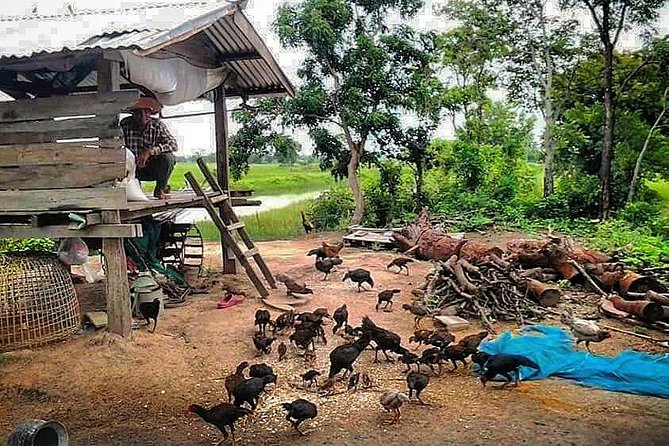
Wat Banan is the main temple stop, and reaching it requires a climb up an old staircase on the mountain. The tour allows about two hours here, giving you time to make the ascent, explore the temple, and take in the countryside around it.
The stairs are the key practical issue. If you are uncomfortable with long climbs, take your time and use the stop as a slow visit rather than a race. The route is active, with cycling earlier in the day and more walking at the temple.
The reward is a hilltop temple setting that feels removed from the city. You see rural Cambodia from above, with rice fields and working farmland forming the backdrop. The scenery is a useful contrast to the compact streets of Battambang and the close village roads earlier in the day.
The tour may also stop with local people baking bamboo sticky rice while traveling toward Wat Banan. This adds another food lesson to the temple visit, though the wording suggests it can depend on the route and timing.
Wat Banan is best for you if you enjoy places that require a little effort. It is less suitable if you want a purely vehicle-based sightseeing day. The stairs are not a minor detail, so wear shoes you can walk and climb in comfortably.
Phnom Sampov, rice fields, and the bat cave
After Wat Banan, the route continues toward Phnom Sampov Mountain. The drive or tuk-tuk journey gives you views of rice fields and farmers working in the fields, bringing the day back to rural life after the temple climb.
The bat cave is one of the most memorable natural sights associated with Phnom Sampov. The supplied information identifies Battambang’s bat caves as part of the experience, although it does not give a precise viewing time or describe the exact cave access. You should therefore follow the guide’s instructions and be prepared for a site that may involve walking around the mountain area.
The mountain section is also where the day becomes more varied. You move from outdoor scenery and village life into Cambodia’s twentieth-century history. That shift can feel abrupt, but it is important. A good guide helps connect the physical places with the events that shaped the region.
The Killing Cave and Cambodia’s painful past
The Killing Cave at Sampov Mountain is the most sobering stop. You see human skulls and learn about victims killed during the Khmer Rouge period.
This is not a light sightseeing attraction, and the tour gives the Phnom Sampov section up to three hours. You should allow yourself time to take in the site respectfully. The cave is a memorial and historical place, not simply another scenic viewpoint.
This is where the guide’s role matters most. Mr Lychee is praised for explaining Cambodian history, religion, and culture in a way that gives the stops more meaning. Sambath is also praised for caring about the people he guides and for explaining food, culture, and history clearly.
If you prefer a day made only of cheerful activities, this part may feel heavy. I would not skip it for that reason, but I would set your expectations correctly. The Killing Cave asks for attention and respect, and it gives the day a serious moral center.
How demanding is the cycling?
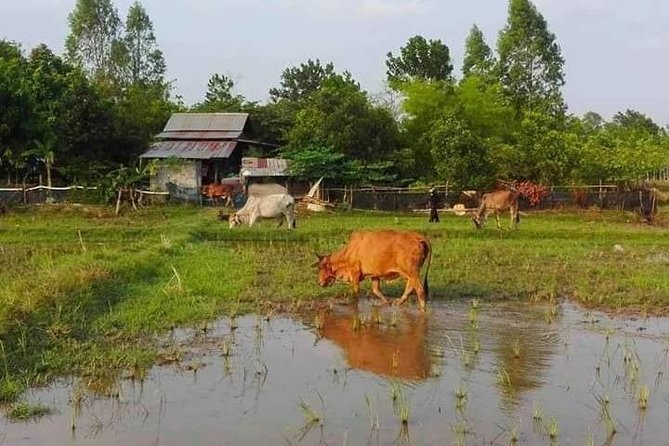
The cycling is a major part of the experience, not a token ride between vehicle stops. One account describes covering about 45 kilometers, though the exact distance may vary according to the route and conditions.
The encouraging point is that Cambodia’s countryside is described as mostly flat and the pace as manageable. A less confident cyclist reported that the distance felt less intimidating because of the relaxed speed. That does not mean the day is effortless. Heat, sun, rougher rural surfaces, and the temple staircase can all add up.
The mountain bike and helmet are included, along with unlimited mineral water and a cold towel. Those practical touches make a difference. You should still bring clothing suited to cycling, sun protection, and footwear that works for both riding and stairs.
A private or very small group also helps. The guide can usually explain the route and adjust the rhythm more easily than on a large organized excursion. Confirm the cycling distance and whether an alternative vehicle arrangement is possible if you are unsure about your fitness.
What the $15 price really gives you
At $15, this appears to offer strong value for a full day, especially with hotel pickup and drop-off, a guide, tuk-tuk transport, bicycle and helmet rental, water, a cold towel, and the listed entrance fees. Lunch is also included in the description.
There is a catch: the pricing information mentions an additional $5 per person for fees and taxes, while another section says all fees and taxes are included. The bamboo train admission is also specifically listed as extra. Ask for a final price that includes every compulsory charge before you pay.
Even with those additions, the package can make financial sense because it combines several separate outings: city sights, village cycling, the bamboo train, Wat Banan, Phnom Sampov, the bat cave, and the Killing Cave. Booking each element separately could cost more and would require arranging transport between widely spaced sites.
Tips and personal spending are not included. Group discounts are available, but the conditions are not stated, so ask about them if you are traveling with friends or family.
The guide can make or break the day
The strongest praise centers on the guides. Mr Lychee is described as friendly, proud of his city, and able to explain local culture, religion, and history in good English. Sambath is also praised for his English, his care for the people he leads, and his broad explanations.
That personal approach suits this route. The sights are spread out, and the value comes from understanding what you are seeing. A colonial building means more when you know how it fits into Battambang. A pagoda means more when someone explains Buddhist practice. A food stop feels more useful when you learn why the food is prepared that way.
The tour provider is Battambang Tour: Mr Lychee, but guide assignment may vary. If having Mr Lychee or Sambath specifically is important, request that in advance rather than assuming it is guaranteed.
Who should book this Battambang experience?
You should consider this tour if you want an active day that mixes local life, food, transport history, temples, scenery, and Cambodia’s difficult past. It suits couples, friends, and independent visitors who prefer a small group and want a guide to provide context.
It is also a good choice if you have limited time in Battambang. The route covers many of the area’s best-known stops without making you arrange several separate tuk-tuk trips.
I would think twice if you dislike cycling, have trouble with stairs, or want a slow day with only two or three stops. The schedule is full, and the 45-kilometer estimate is worth taking seriously. The Killing Cave may also be emotionally difficult, especially if you are not prepared for a memorial connected with mass violence.
Free cancellation is available up to 24 hours before the start time. Changes or cancellations made later are not accepted, so keep that deadline in mind.
Should you book it?
Book this tour if you want the most varied introduction to Battambang and are comfortable with a physically active day. The mix of bicycle roads, village stops, bamboo train, Wat Banan, and Phnom Sampov offers more local contact than a simple temple circuit.
Before booking, confirm the final price, bamboo train charge, expected cycling distance, lunch arrangements, and guide availability. If those details suit you, this is a good-value day with real substance, not just a string of photo stops.
FAQ
How long does the Battambang tour last?
It is described as a full-day experience, with the booking information showing an approximate duration of 1 day and 16 hours. The listed itinerary includes around one hour in Battambang, two hours at the suspension bridge and pagoda area, one hour on the bamboo train, two hours at Wat Banan, and three hours around Phnom Sampov.
Is hotel pickup and drop-off included?
Yes. Hotel pickup and drop-off are included, with transportation provided by traditional tuk-tuk.
Is the bamboo train ticket included?
No. The bamboo train admission is specifically listed as not included. The price information also mentions an additional $5 per person for fees and taxes, so confirm the final cost before departure.
How much cycling is involved?
One account describes cycling about 45 kilometers. The route is said to be mostly flat and taken at a manageable pace, but you should still prepare for a physically active day.
Is lunch provided?
Yes. The experience includes lunch at a typical Cambodian restaurant. Local snacks such as dried banana and fried spring rolls are also mentioned, along with possible food-making stops.
Can I cancel for a full refund?
Yes, if you cancel at least 24 hours before the experience start time. Cancellations or changes made less than 24 hours before the start time are not accepted for a refund.
Just added around Cambodia
- Oudong Temples & Phnom Prasith Private Tour from Phnom Penh★ 5.0 · 11 reviews
- Grand Tour-Ek Phnom. Baset. Bamboo Train. Wat Banan. Phnom Sampov★ 5.0 · 20 reviews
- Morning Tour,Ak Phnom temple,Rice wine,Rice Paper, killing Field★ 5.0 · 22 reviews
- Two Days Angkor Wat Park-Beng Mealea and Kampong Phluk Village★ 5.0 · 14 reviews
- 2-Days in temples and other areas★ 5.0 · 101 reviews
- Sunrise at Angkor Wat Temple: 3-Hour Private Tour★ 4.7 · 30 reviews
- Small-Group Explore Angkor Wat Sunrise Tour with Guide★ 5.0 · 3 reviews
- SiemReap: Private Angkor Wat Tour in English or German guide★ 5.0 · 5 reviews
Train Experiences, compared.
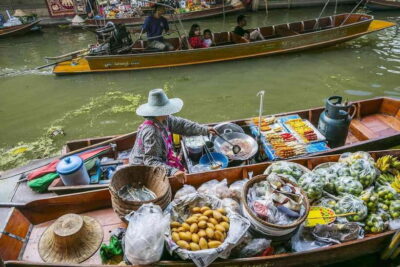
Railway and Floating Market Tour with Dragon Temple
Read our review →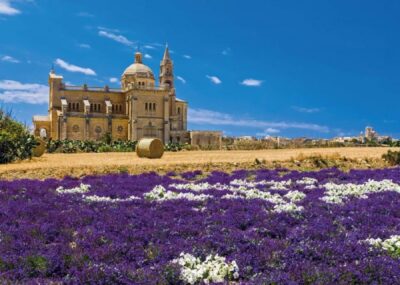
From Malta: Gozo Full-Day Tour with Guide, Temples, & Train
Read our review →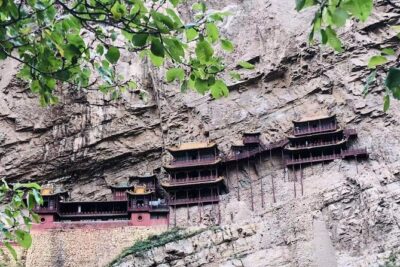
Beijing to Datong See YunGang Cave, Hanging Temple (Bullet Train)
Read our review →
From Thessaloniki: Train Trip to Meteora & Monastery Tour
Read our review →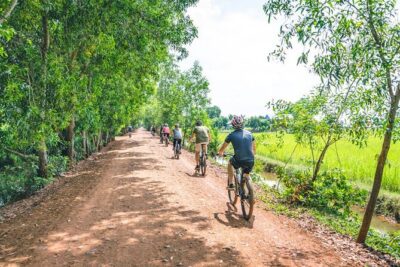
Grand Tour-Ek Phnom. Baset. Bamboo Train. Wat Banan. Phnom Sampov
Read our review →
Bullet Train Tour to Hanging Temple&Yungang Grottoes
Read our review →
Full-day: Original bamboo train, Wat Banan, Phnom Sampov
Read our review →
Private Floating & Train Market + DRAGON Temple + Thai Cafe
Read our review →Browse the lists this tour appears in