
Review · SPAIN
Granada: Monastery of San Jerónimo Entry Ticket
Quiet stone, bold art, and royal history.
I like the way this self-guided visit lets you explore San Jerónimo Monastery at your own pace, from the Compass and Gothic Processional Cloister to the church’s striking Renaissance interior. I also like the chance to see the tomb chapel created for the Great Captain, one of Spain’s best-known military figures. The main drawback is value: at about $11 per person, the ticket may cost more than buying admission at the monastery, and it is non-refundable.
You should allow much of a day for validity, but the actual visit is focused rather than lengthy. I would choose it for the architecture, religious art, and calm atmosphere, not for a guided story or a long list of activities. A 4.1 rating from 21 bookings suggests a generally good experience, though not every visitor found the site equally rewarding.
Key points to know before you go
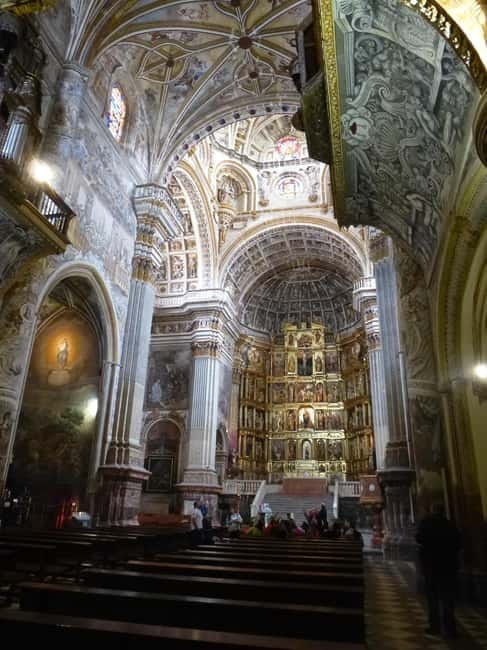
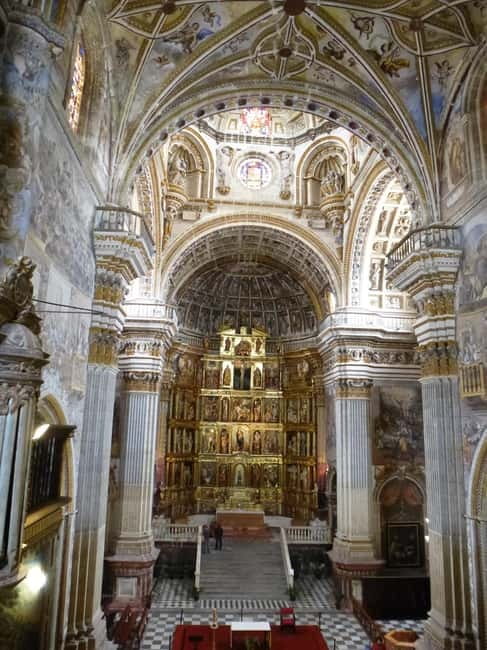
- The church is the star: Diego de Siloé’s design leads to an impressive interior with a fine Mannerist altarpiece.
- The Great Captain’s chapel matters: The Main Chapel was built as the burial place of Gonzalo Fernández de Córdoba and his wife, Doña María de Manrique.
- The Gothic Processional Cloister sets the mood: This was the working heart of monastic life and gives the visit its quiet rhythm.
- The Empress Cloister is closed: You can see it from the Processional Cloister, but you cannot enter the cloistered area.
- The ticket includes an audio guide app: You need a smartphone for that feature, yet the rules also state that cellphones are not allowed inside, so check how the audio guide is handled before relying on it.
- Buy with care: Several bookings praised the monastery but found on-site admission cheaper, sometimes by about 3 euros or roughly 30 percent.
Why San Jerónimo Monastery deserves your time
San Jerónimo is not Granada’s largest attraction, and it does not have the instant fame of the Alhambra. That is part of its appeal. The visit gives you a closer look at the religious and royal world that shaped Granada after the Christian conquest.
The monastery was founded by the Catholic Monarchs in 1492, at the military camp in nearby Santa Fe. The first site proved unsuitable, so the project moved to Granada. Construction began at its present location in 1503, and the institution took the name Real Monasterio de la Concepción de Nuestra Señora de Granada.
Hieronymite monks began living here in 1521. They remained until the disentailment of Mendizábal in 1835, when the monastery was turned into a barracks. In the 1960s, the property was returned to the Order of St. Jerome. After restoration, it again became a religious house. In 1977, Hieronymite mothers moved here from the former Monastery of Santa Paula.
That history gives the rooms more weight. You are not simply walking through decorated corridors. You are seeing a place that changed from royal foundation to working monastery, military barracks, restored religious house, and active convent.
More Entry Tickets in Spain:
- Montserrat Museum and Monastery Entry Ticket
★ 4.5 · 1,740 reviews - Mallorca: Carthusian Monastery Valldemossa Entrance Ticket
★ 4.2 · 93 reviews - Barcelona: Montserrat Private Trip with Monastery Ticket
★ 5.0 · 74 reviews
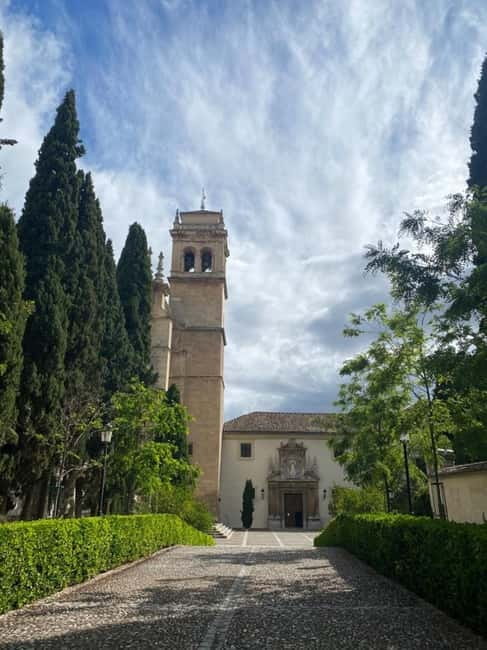
Start in the Compass beneath Diego de Siloé’s facade
Your route begins in the Compass, a transition space between Granada’s city streets and the monastery’s quieter interior. This area is useful because it gives you a moment to shift gears before the more detailed architecture begins.
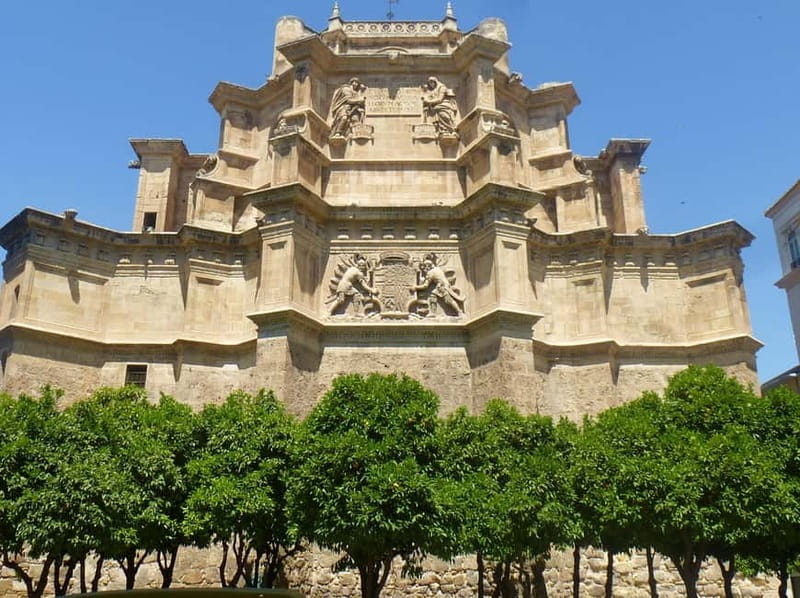
Look first at the church facade. Diego de Siloé is the leading name connected with the design, joined by Martín Díaz de Navarrete and Pedro de Orea. The facade gives you an early clue about what lies ahead: a building where sculpture, architecture, royal ambition, and religious devotion are closely linked.
I would spend a few minutes here rather than rushing straight indoors. The Compass is not just an entrance point. It helps explain the monastery’s original role as a protected religious complex, set apart from everyday city life.
The exterior is also one of the clearest reasons to visit if you care about Spanish Renaissance design. The facade can be appreciated without needing a full art-history background, though the audio guide app should add useful context if you can use it under the site’s cellphone rules.
Walk the Gothic Processional Cloister
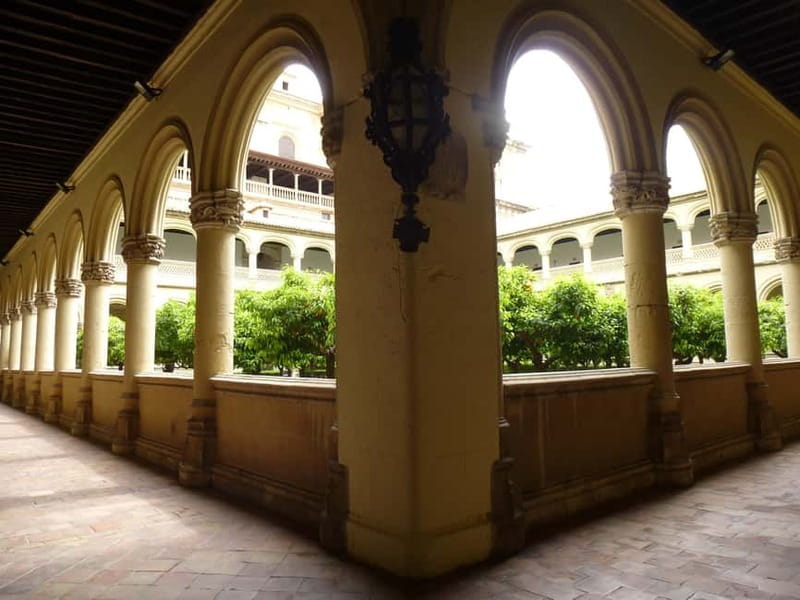
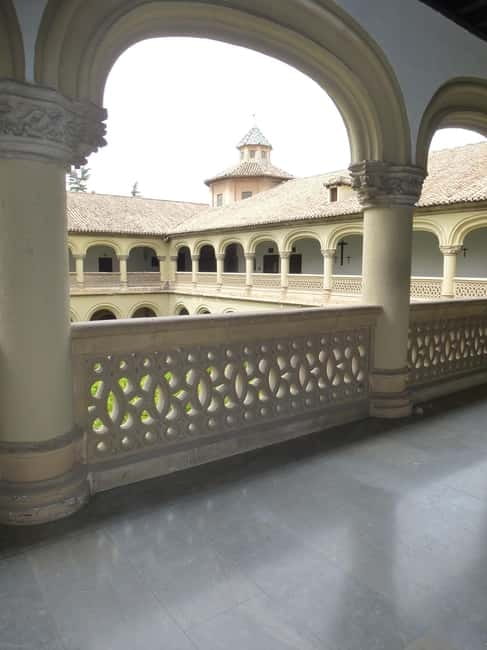
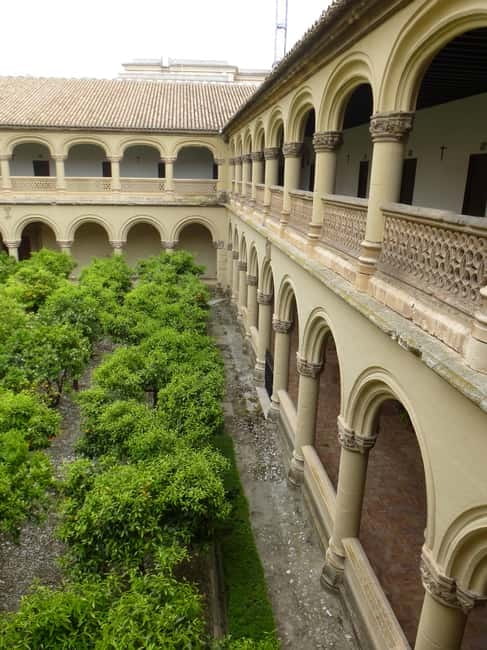
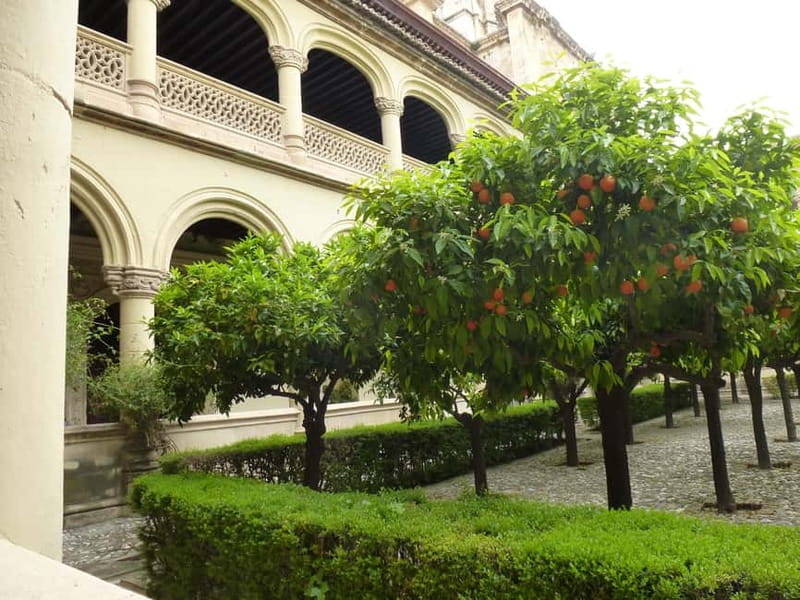
The Processional Cloister, also called the Main Cloister, is the architectural center of the visit. It is Gothic in style and was the space where the monks carried out much of their daily life.
The cloister gives you a strong sense of order. Its covered walkways frame the central open space, while the surrounding rooms explain how a monastery worked. You can move from the city-facing entrance into a world built around repetition, prayer, meals, meetings, and quiet movement.
This is likely the most peaceful part of the tour. One booking described the site as beautiful and calm, and that assessment fits the cloister especially well. The atmosphere is less about spectacle and more about proportion, stone, and silence.
From here, you can see the Empress Cloister. You cannot enter it because it is a cloistered area where the Hieronymite mothers live. The name comes from Isabel of Portugal, wife of Charles I of Spain and V of Germany. She stayed there for much of her time in Granada in 1526.
That restriction is worth knowing before you arrive. If you expect access to every courtyard, you may feel disappointed. Still, seeing the Empress Cloister from the Processional Cloister connects the architecture with a specific royal episode rather than leaving it as an anonymous decorative space.
See how monastic life worked in the refectory and chapter rooms
The refectory was the communal dining room. It is a modest but important stop because it moves your attention away from grand art and toward daily routine. Monasteries were living communities, and rooms such as this one show how the religious order organized ordinary life.
The profundis room adds another piece to that picture. The name refers to a religious setting associated with prayer for the dead, giving the room a more solemn purpose than the dining spaces nearby.
You can also visit two chapter rooms. These were used for community business and religious meetings. Together, the refectory, profundis room, and chapter rooms make the monastery easier to understand. They show that San Jerónimo was not only a church with beautiful decoration. It was a functioning institution with rules, meals, prayer, and administration.
I appreciate this part of the route because it keeps the visit from becoming a quick church stop. If your interest is only in large paintings and ornate altarpieces, these rooms may feel less exciting. If you want to understand how the monastery operated, they are essential.
A few more temple visits around Spain worth a look
- Montserrat Monastery Half Day Experience from Barcelona
★ 5.0 · 6,014 reviews - Montserrat Monastery Small Group or Private Tour Hotel pick-up
★ 5.0 · 5,144 reviews - Escorial Monastery and the Valley of the Fallen Tour from Madrid
★ 5.0 · 2,494 reviews - Montserrat Small Group: Monastery, Black Madonna & Natural Park
★ 5.0 · 1,690 reviews
Find the Child Jesus of the Battles in the sacristy
The sacristy contains the Child Jesus of the Battles, an image said to have accompanied the Great Captain during his military campaigns. The Great Captain was Gonzalo Fernández de Córdoba, a leading commander associated with the Catholic Monarchs.
This small detail links the monastery to military history in a personal way. Instead of seeing only a distant nobleman’s tomb or a grand chapel, you encounter an object connected with his campaigns and religious devotion.
The sacristy is also a reminder that religious buildings often preserve stories through objects as much as through architecture. Take time to read or listen to the explanation here. Without context, the image may seem like one more devotional sculpture. With context, it becomes one of the visit’s more memorable pieces.
Enter the Immaculate Conception Church
The church is the high point of the visit. It is dedicated to the Immaculate Conception and can be reached from the Processional Cloister.
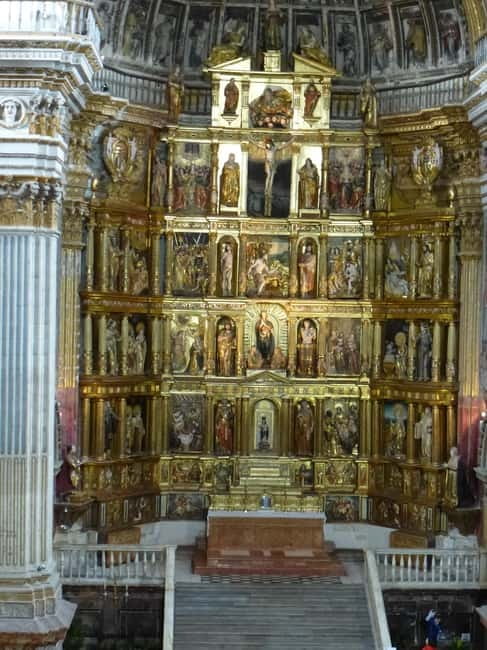
The church’s strongest feature is the Main Chapel, built in Renaissance style by Doña María de Manrique, Duchess of Sessa. She created it as a pantheon for her husband, the Great Captain. Diego de Siloé built it according to ideas first proposed by Jacobo Florentino.
That combination of personal mourning, military status, royal service, and religious devotion gives the chapel real purpose. It was not designed simply to fill a room with decoration. It was intended to preserve a family’s memory and position.
Look closely at the Mannerist altarpiece. Many artists worked on it, including Juan de Aragón, Lázaro de Velasco, Pedro de Orea, Pedro de Raxis, Bernabé de Gaviria, Vázquez el Mozo, and Rojas. The result is a layered work of art that rewards slow looking.
The church is also where the architectural story comes together. The facade outside introduces Siloé’s design. The cloister shows the monastery’s daily structure. The church gathers the site’s artistic ambition into one space.
One of the strongest recent responses described the church as breathtaking. That praise is easy to understand, especially if you enjoy Renaissance and Mannerist interiors. At the same time, one four-star assessment found the site less compelling overall. I would take that as a useful warning: the church may impress you greatly, but the entire visit depends on how much you enjoy quieter historical rooms and religious architecture.
How much time should you allow?
The ticket is valid for one day, with availability tied to the selected starting time. That gives you useful flexibility on the day of your visit, though the experience itself is not presented as a full-day guided program.
You can expect a compact route through:
- The Compass
- The Processional Cloister
- The refectory
- The profundis room
- Two chapter rooms
- The sacristy
- The Church of the Monastery
I would plan enough time to pause in the cloister and church rather than treating this as a quick in-and-out admission. The site has more value when you look at the relationship between the rooms.
There is no guided tour included. The audio guide app on your smartphone is the main aid provided. Since the rules list cellphones among the items not allowed, you should confirm the current arrangement before arrival. That is the clearest practical issue in the ticket description.
Is the $11 ticket good value?
At $11, the price is reasonable if convenience matters to you and the on-site price is similar. You are paying for access to a historically important monastery, its church, cloister, sacristy, and several rooms, plus the booking fee and audio guide app.
The value becomes less certain if you are comfortable buying directly at the entrance. A five-star booking from France specifically noted that the same admission was 3 euros cheaper on site, with no wait. Another booking estimated that using this booking route added about 30 percent to the admission price.
Those comments do not make the monastery a poor choice. They make the ticket purchase worth checking. Compare the direct price before paying, especially if you have a flexible schedule and do not need advance booking.
The ticket is non-refundable, so avoid buying until you are sure about the date and starting time. Also remember that the package does not include a guide. If you prefer a person explaining the art and history as you go, this is not the right format.
Who will enjoy this visit most?
I would recommend San Jerónimo to you if you like:
- Renaissance and Mannerist art
- Gothic cloisters
- Monastic architecture
- Royal and military history
- Quiet cultural sites
- Self-guided visits at your own pace
The monastery suits travelers who want more than Granada’s headline attractions. It is also a good choice if the Great Captain, the Catholic Monarchs, Isabel of Portugal, or Diego de Siloé already interest you.
I would be more cautious if you want a lively guided experience, broad access to every part of the monastery, or a large number of attractions in one ticket. The Empress Cloister is closed, and the route is focused on a small number of rooms.
The site is not suitable for wheelchair users according to the supplied access information. Smoking, food, drinks, and pets are not allowed, although assistance dogs are permitted. The cellphone rule deserves special attention because the ticket includes an audio guide app.
Should you book the Monastery of San Jerónimo?
Book it if you want a calm, art-focused stop with a particularly strong church and a fine Gothic cloister. The Main Chapel, the Great Captain connection, and the Mannerist altarpiece give the visit more substance than a quick look at the facade would suggest.
Before booking, compare the price with direct admission. If the on-site ticket is notably cheaper and you can visit without a wait, buying there may be the better deal. If you prefer the convenience of an arranged ticket, $11 is fair, but remember that the ticket cannot be refunded and no live guide is included.
My call: worth visiting, but not necessarily worth booking online without checking the price first. Go for the church, cloister, and history. Skip it if you need a fully guided or wheelchair-accessible experience.
FAQ
Where is the Monastery of San Jerónimo?
The Monastery of San Jerónimo is in Granada, in Andalusia, Spain.
What does the ticket include?
The ticket includes entry to the Monastery of San Jerónimo, an audio guide app on your smartphone, and the booking fee.
Which parts of the monastery can I visit?
The route includes the Compass, Processional Cloister, refectory, profundis room, two chapter rooms, sacristy, and Church of the Monastery.
Can I enter the Empress Cloister?
No. The Empress Cloister is a cloistered area where the Hieronymite mothers live. You can see it from the Processional Cloister.
Is a guided tour included?
No. A guided tour is not included. The ticket includes an audio guide app on your smartphone.
How long is the ticket valid?
The ticket is valid for one day. You need to check availability for the starting times.
Can I cancel the booking?
No. The activity is non-refundable.
Is the monastery suitable for wheelchair users?
No. The experience is listed as unsuitable for wheelchair users.
Just added around Spain
- Montserrat Monastery Horse Riding & Walk – Small Group (Max 8)★ 5.0 · 45 reviews
- Montserrat Nature Walk, Monastery and Museum from Barcelona★ 5.0 · 58 reviews
- Montserrat & beyond private from Barcelona with different options★ 5.0 · 32 reviews
- Transfer to Montserrat Monastery from Barcelona★ 4.5 · 94 reviews
- Montserrat Tour with Cogwheel Train, Monastery & Black Madonna★ 4.0 · 10 reviews
- Private Montserrat & Hot-Air Balloon Ride with Monastery visit★ 4.5 · 5 reviews
- Montserrat Monastery and Mountain Half Day Hiking from Barcelona★ 4.5 · 6 reviews
- Montserrat Horseback Riding & Monastery – Small Group (Max 8)★ 5.0 · 45 reviews
Spain Temple Tours, compared.
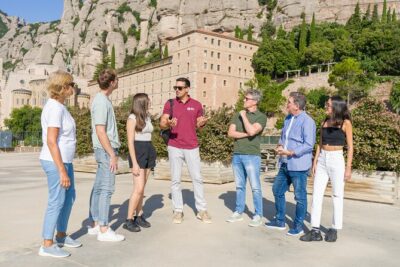
Montserrat Monastery Half Day Experience from Barcelona
Read our review →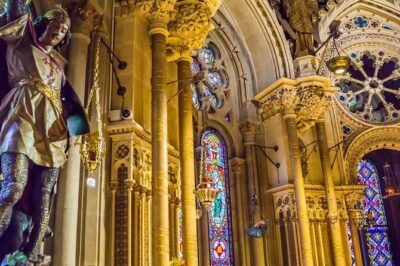
Montserrat Monastery Small Group or Private Tour Hotel pick-up
Read our review →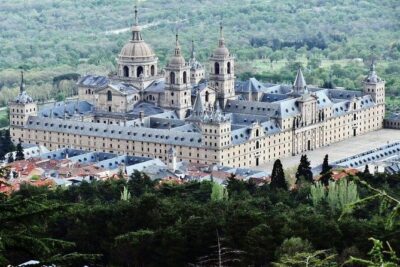
Escorial Monastery and the Valley of the Fallen Tour from Madrid
Read our review →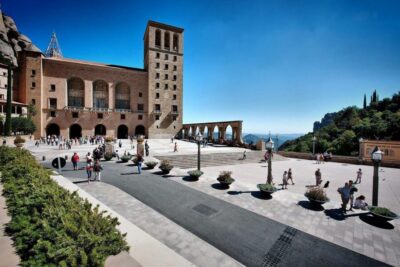

Montserrat Small Group: Monastery, Black Madonna & Natural Park
Read our review →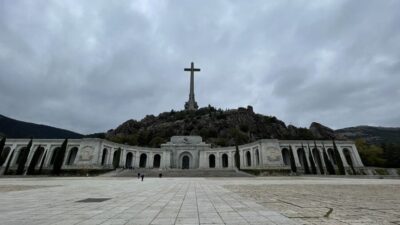
Escorial Monastery and the Valley of the Fallen
Read our review →
Flamenco Show at Tablao Sala Temple with Drink
Read our review →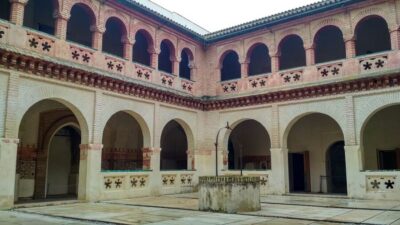
From Seville: Italica Roman City & Medieval Monastery Tour
Read our review →Browse the lists this tour appears in