Review · ACROPOLIS & ANCIENT GREEK
Visit Acropolis Parthenon & Private Luxury Sunset PoseidonTemple
Athens saves its best for last. This private day combines the Acropolis, ancient temples, grand neoclassical buildings, Lycabettus Hill, and the Temple of Poseidon in one long outing. I like the way it connects central Athens with the Athenian Riviera, so you see both the city’s ancient heart and its sea-facing edge.
I also like the private format. Your group gets hotel, Airbnb, port, or airport pickup, a clean vehicle with air-conditioning, Wi-Fi, and bottled water, plus an English-speaking driver who can explain Greek history along the way. The main drawback is clear: entrance fees are not included, and the schedule is packed enough that you will need to accept brief visits at several sites.
Key points to know before booking
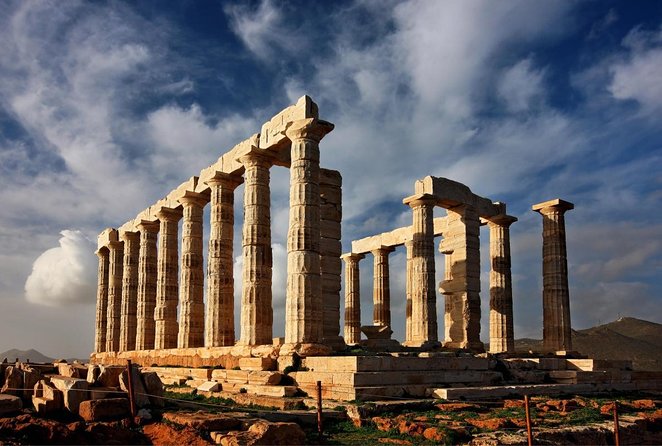
- Sunset at the Temple of Poseidon: The final stop brings you to a Doric temple perched above the Aegean Sea at Cape Sounion.
- A full Athens circuit: The route includes the Acropolis, Parthenon, Ancient Agora area, Temple of Olympian Zeus, Panathenaic Stadium, Plaka, and the neoclassical center.
- Private transportation: Groups of one to three use a luxury sedan, while groups of four to seven use a luxury minivan.
- Driver, not automatic site guide: Your English-speaking driver provides historical context, but is not licensed to accompany you inside archaeological sites unless you arrange and pay for a licensed guide.
- A long, tightly timed day: The experience lasts about eight to nine hours, with a great deal of ground covered.
- Good flexibility: The program can be customized, which matters if you want more time at the Acropolis and less time at smaller stops.
The Acropolis comes first
Your day begins with pickup from your Athens hotel, apartment, Airbnb, Piraeus port, or, for an added fee, the airport. Starting at the Acropolis makes sense. It puts the city’s most important ancient site first, before the day becomes too hot or the schedule starts to feel rushed.
The Acropolis is more than one monument. This rocky hill was the religious center of ancient Athens, and its position above the city gives you an immediate sense of why it mattered. You will walk among remains linked with the political, artistic, and philosophical life of classical Athens.
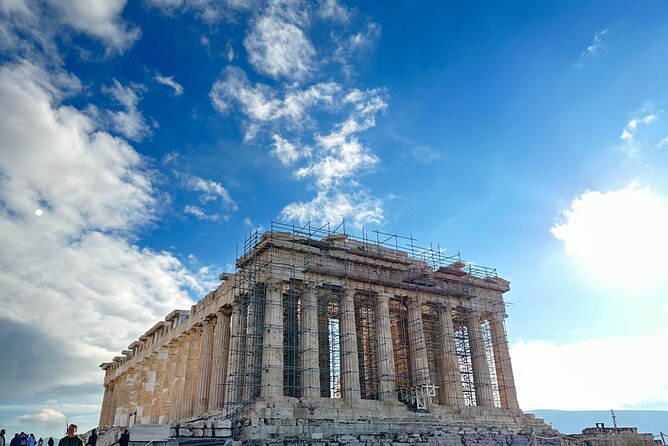
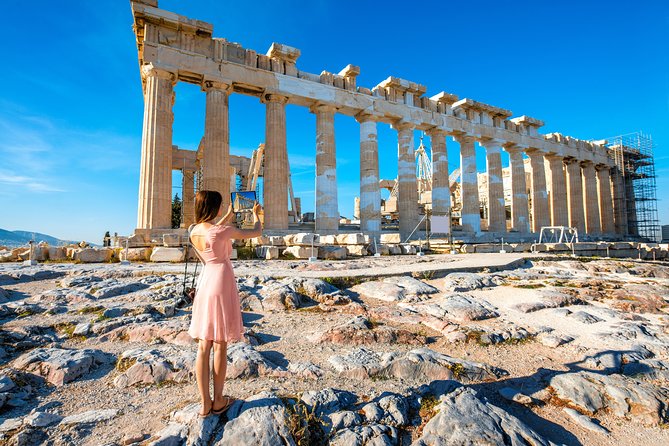
The Parthenon is the main event. Built in the fifth century BC and dedicated to Athena, it is famous for its Doric design, careful proportions, and sculptural decoration. You will not see a complete building, but the surviving columns and stonework still have enormous power. The guide-driver can help connect the ruins with the wider story of Periclean Athens.
The Propylaea, the monumental entrance to the Acropolis, gives you a grand approach to the hilltop. It was part of Pericles’ rebuilding program after the Persian Wars. Nearby, the small Temple of Athena Nike sits on a projecting bastion. Its position beside the entrance is easy to miss if you are focused only on the Parthenon, so it is worth pausing there.
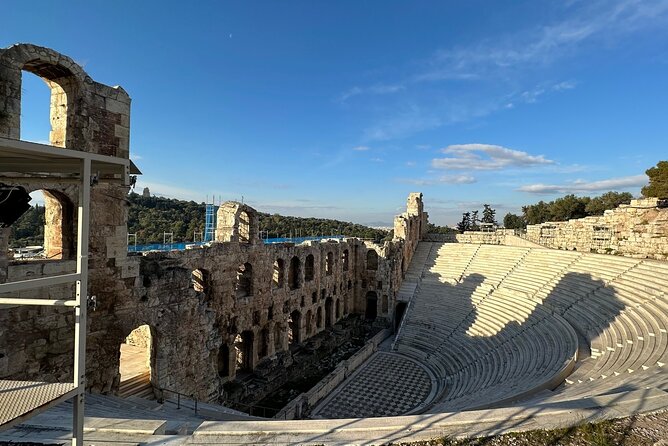
The route also includes the Theater of Dionysus on the southern slope. This is the birthplace of classical Greek theater, where plays connected with the City Dionysia were performed. The theater once held up to 17,000 people. Fifteen minutes is enough to understand the setting, but not enough for a detailed examination.
More Temple Sunset Tours in Athens
- Athens: Cape Sounion & Poseidon Temple Sunset Half-Day Trip
★ 4.8 · 8,241 reviews - Athens: Cape Sounion & Temple of Poseidon Sunset Experience
★ 4.3 · 1,338 reviews - Temple of Poseidon and Cape Sounion Sunset Tour with Audio Guide
★ 4.5 · 542 reviews
Why the Acropolis timing matters
The Acropolis portion is listed as roughly two hours, with separate time allocations for the Parthenon, Propylaea, Athena Nike, and Theater of Dionysus. That sounds generous until you remember that the hill is large, exposed, and filled with major monuments.
I would treat this as an orientation visit rather than a slow archaeological study. If the Acropolis is your main reason for coming to Athens, ask to protect the hilltop time and trim some of the smaller stops. The private format makes that possible.
All major admissions are extra, including the Acropolis and Parthenon. Check the total cost before booking because the advertised price of $197.79 per person does not include entry tickets, meals, or a licensed guide. For one or two people, that price can be reasonable for private transport and a full-day route. For a larger group, the per-person value may improve, especially since the vehicle can carry up to seven people.
The Acropolis Museum adds the missing details
The Acropolis Museum sits at the foot of the hill and provides the context that open-air ruins cannot. Its collection includes sculpture and architectural pieces from the Acropolis, presented in a modern setting with views toward the Parthenon.
The planned visit is about 45 minutes. That is enough to see important highlights, but you will need to move with purpose. If you want time for the museum’s full collection, ask about adjusting the schedule.
The museum admission is not included. That is another cost to add beside the Acropolis ticket, and it is worth knowing before you arrive. I consider the museum especially useful after seeing the hill, because you can recognize where many sculptures and architectural elements originally belonged.
Ancient Athens below the hill
After the Acropolis, the route moves through several landmarks in central Athens. The Arch of Hadrian is a quick photographic stop near the Temple of Olympian Zeus. This Roman gateway once marked the transition between the old Greek city and the area developed under the Roman emperor Hadrian.
The Temple of Olympian Zeus is one of Athens’ most impressive ruins simply because of its scale. Construction began in the sixth century BC, but the temple was not completed until the second century AD under Hadrian. Only a small number of columns remain, yet their height gives you a clear idea of the original building’s size.
The visit is listed at about 45 minutes, though the exact time may depend on traffic and the rest of the day. Admission is extra. The temple is exposed, with little shade, so water and practical footwear matter.
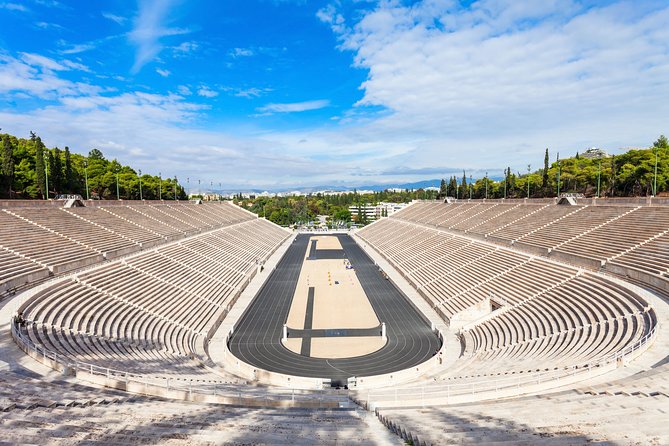
The Panathenaic Stadium is another quick but worthwhile stop. It was rebuilt in marble by Herodes Atticus in the second century AD and later hosted the opening and closing ceremonies of the first modern Olympic Games in 1896. Its long, curved seating bowl makes the site easy to understand even during a short visit.
The scheduled time is about 15 minutes, and admission is not included. That is enough for a look and photographs, but not for a full museum visit or a slow walk around the stadium.
More Temple Sunset Tours in Greece
- Athens: Cape Sounion and Poseidon Temple Sunset with Audio Guide
★ 4.5 · 405 reviews - Athens: Sunset Tour to Cape Sounion & the Temple of Poseidon
★ 4.3 · 360 reviews - Cape Sounion & Temple of Poseidon Sunset Experience
★ 4.0 · 206 reviews - Private Sunset Tour of Cape Sounion, Temple of Poseidon & Athens Riviera
★ 5.0 · 78 reviews
The Neoclassical Trilogy and modern Athens
The drive through the center includes the Academy of Athens, the University of Athens, and the National Library of Greece. Together, these buildings form Athens’ famous Neoclassical Trilogy.
The Academy is Greece’s national research institution. The University of Athens has operated since 1837 and was the first modern university in the newly established Greek state. The National Library building was designed by Danish architect Theophil Hansen, who also designed the Academy and University buildings.
These stops are mainly visual, with a short visit at the Academy and views of the other buildings. They provide a useful change of pace after the ancient ruins. You see how nineteenth-century Greece used classical forms to create a modern national identity.
The Academy stop is free. The route does not promise extended interior visits at the university or library, so think of this section as a city drive with brief pauses rather than a formal architectural tour.
Lycabettus Hill gives you the city from above
Lycabettus Hill rises 277 meters above sea level and is the highest point in the central Athens basin. A small church dedicated to Saint George sits at the summit, and a cable car serves the hill.
The planned stop lasts about 45 minutes and is free. This is one of the best places on the route to understand Athens as a whole. From above, the ancient center, dense modern neighborhoods, and distant sea come together in one view.
There is also a local myth connected with the hill. The goddess Athena is said to have dropped the rock after hearing bad news brought by a crow. According to the story, the crows then turned black.
The hill can be a practical highlight for photographers and first-time visitors, but it also depends on visibility. Ask the driver about the best timing on the day. If the air is hazy, you may prefer extra time at the Acropolis or the coast.
Plaka, the Roman Agora, and the Tower of the Winds
Plaka spreads across the slopes below the Acropolis. Its narrow lanes, older houses, and neoclassical buildings give you a break from broad city avenues and major monuments. The neighborhood is known as the Neighborhood of the Gods because of its position beside the Acropolis and several archaeological sites.
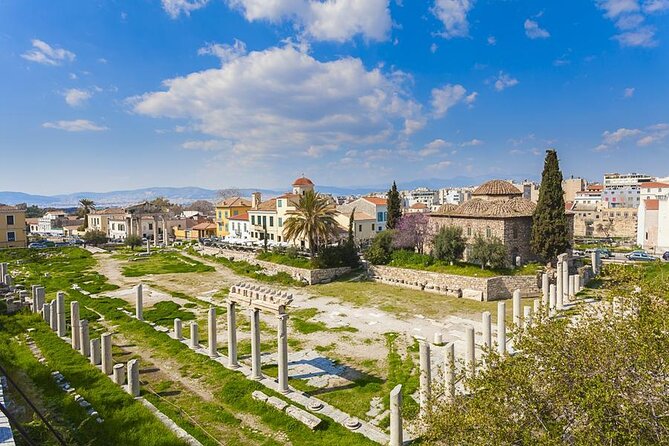
The Roman Agora is one of those sites. Built during the Roman period, it served as a commercial and public center after the older Agora became crowded with new buildings. The Tower of the Winds is its best-known feature, an ancient marble clock tower that also functioned as a weather station.
The Roman Agora visit is listed at about 45 minutes, while the Tower of the Winds gets about 10 minutes. The Tower admission is included, but the Roman Agora admission is not. That difference is easy to miss when planning your budget.
This part of the route is particularly useful if you want to see how Greek and Roman Athens overlapped. It is also a good place to ask for a short refreshment break, though lunch and drinks are not included.
The road to the Athenian Riviera
The journey south changes the mood of the day. You pass through Glyfada and the coastal suburbs before reaching Lake Vouliagmeni. Glyfada is one of Athens’ best-known southern districts, stretching from Mount Hymettus toward the Saronic Gulf.
Lake Vouliagmeni is a small brackish lake fed by underground currents beneath Mount Hymettus. The planned stop is only about 10 minutes and admission is free. That makes it a short scenic pause rather than a swimming visit or a full nature outing.
You also pass through Varkiza before reaching Cape Sounion. These coastal suburbs help show that Athens is not only an inland archaeological capital. It is also a city connected to beaches, marinas, and the sea.
Sunset at the Temple of Poseidon
Cape Sounion lies at the southern tip of the Attic Peninsula, roughly 59.6 kilometers from Athens. The drive is a major part of the experience, so you should be comfortable spending a long day in the vehicle.
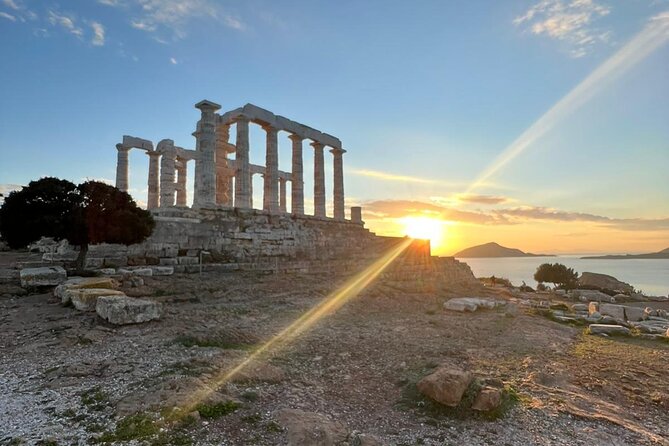
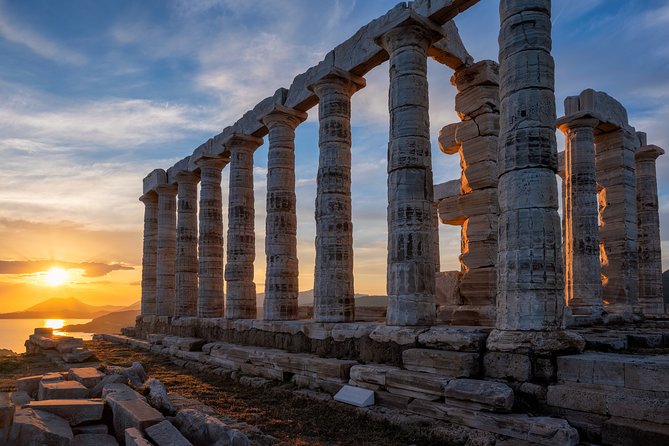
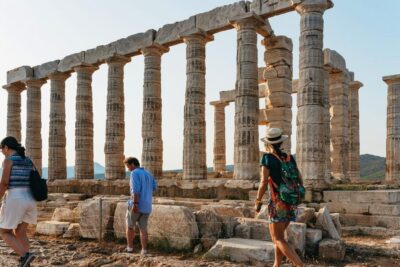
The Temple of Poseidon is the payoff. Built between 444 and 440 BC, it is a Doric temple set almost 60 meters above the sea. Three sides of the headland open toward the water, giving the ruins a dramatic setting that feels very different from the enclosed streets of central Athens.
The archaeological site visit is listed at about one hour, followed by roughly 30 minutes at the temple itself. Admission is extra. The timing should allow you to walk around the remains and watch the changing light, but the exact sunset experience depends on the season, traffic, and weather.
This is one of those places where the setting matters as much as the architecture. The temple was dedicated to Poseidon, god of the sea, and its position above the Aegean makes the connection immediate. You can look from ancient columns toward the water and understand why Cape Sounion became such an important sacred site.
Because the tour requires good weather, poor conditions can lead to a different date or a full refund. Even on a clear day, bring a light layer for the coast. The final stop is exposed, and the air can feel cooler after sunset.
What the private vehicle adds
The private setup is the strongest practical reason to choose this experience instead of a standard group excursion. Pickup and drop-off are included from Athens hotels, Airbnb residences, and Piraeus port. Groups of one to three travel in a luxury sedan, while groups of four to seven use a luxury minivan.
Vehicles include Wi-Fi, air-conditioning, and bottled water. Child or infant seats are available if requested in advance. The driver can also customize the program, which matters on a day with this many stops.
The driver is an English-speaking history specialist, but not a licensed guide for the archaeological sites. That means you receive explanations during the drives and at the stops, but you should not expect the driver to conduct a formal guided walk inside every monument. A licensed guide can be requested for an additional cost, subject to availability.
One past customer specifically praised Andreas for bringing Greek history to life and for friendly, timely communication. Another useful tip was to use WhatsApp to avoid international calling charges. The tone of the feedback points to a service that is personal and informal, more like spending the day with a helpful local driver than joining a scripted sightseeing group.
Is $197.79 good value?
The price is easiest to justify when you value privacy, door-to-door transportation, and the ability to adjust the schedule. Driving from central Athens to Cape Sounion and back takes time, and combining that with the Acropolis and city sights would be complicated by public transportation.
The price does not cover entrance fees, meals, drinks, tips, or a licensed guide. Add those costs before deciding. Airport pickup also costs extra, even though airport pickup can be arranged.
For a small group, the total may feel high compared with a simple Acropolis visit. For four to seven people sharing a private minivan, the value becomes stronger. You are paying for transport, comfort, flexibility, and a long route that links places spread across Attica.
Who should book this experience?
I would choose this for a first visit to Athens when you want to see the major ancient sites and Cape Sounion in one day. It also suits cruise passengers arriving at Piraeus port, families who want private transport, and small groups that prefer not to manage several separate taxis.
It is less suitable if you want a slow archaeological study. The schedule covers a lot, and several visits are brief. It may also frustrate you if you assume a licensed guide is included inside the monuments.
You can cancel for a full refund up to 24 hours before the start time. Changes made within 24 hours are not accepted, and bad weather may lead to a new date or full refund.
Should you book it?
Book this tour if your ideal Athens day includes the Acropolis in the morning, a broad look at the city, and a memorable sea view at sunset. The private vehicle, flexible schedule, and personal service from Andreas are strong advantages.
Before booking, ask for the likely timing of the sunset stop and decide which admissions you want to purchase. I would also request a licensed guide if ancient art and architecture are central to your trip. If you prefer depth over coverage, customize the route around the Acropolis, Museum, and Poseidon Temple, and treat the other sights as short scenic stops.
FAQ
How long does the tour last?
The experience lasts approximately eight to nine hours.
Where can pickup and drop-off take place?
Pickup and drop-off are offered at Athens hotels, Airbnb residences, and Piraeus port. Airport pickup is available for an additional cost.
Are entrance fees included?
No. Entrance fees for the Acropolis, Parthenon, Acropolis Museum, Panathenaic Stadium, Ancient Agora, Roman Agora, and Temple of Poseidon are not included.
Is a licensed guide included?
No. The English-speaking driver provides historical information but is not licensed to accompany you inside archaeological sites. A licensed guide may be requested for an extra cost, subject to availability.
What vehicle will my group use?
Groups of one to three people use a luxury sedan. Groups of four to seven people use a luxury minivan. Vehicles include air-conditioning, Wi-Fi, and bottled water.
Can the route be customized?
Yes. The private program can be adjusted according to your needs. If you want more time at the Acropolis or Temple of Poseidon, discuss that before or during the tour.
What happens if the weather is poor?
The experience requires good weather. If it is canceled because of poor conditions, you will be offered another date or a full refund. You can also cancel at least 24 hours before the start time for a full refund.
More Acropolis and Ancient Greek Temple Tours in Athens
- Athens: Cape Sounio & Poseidon Temple Trip with Audio Guide
★ 4.4 · 4,521 reviews - Cape Sounion and Temple of Poseidon Half-Day Small-Group Tour from Athens
★ 4.5 · 3,205 reviews - Cape Sounion & Temple of Poseidon: Small Group Tour
★ 4.7 · 1,945 reviews - From Athens: Temple of Poseidon & Cape Sounion Half-Day Tour
★ 4.3 · 1,082 reviews
Just added around Athens
- Mt. Villages of Arcadia & Clifftop Monastery Private Day Trip★ 4.5 · 5 reviews
- Relax Day: Thermal Lake, Olive Oil Tasting & Poseidon Temple Tour★ 5.0 · 5 reviews
- Mercedes Private Tour to Classical Athens and Temple of Poseidon★ 5.0 · 13 reviews
- Sunset Private Tour to Poseidon Temple & Vouliagmeni Thermal Lake★ 4.5 · 20 reviews
- The adventure of Athens best and Poseidon’s temple in cape Sounion★ 4.5 · 9 reviews
- Temple of Olympian Zeus: Self-Guided Audio Tour on your Phone (without ticket)★ 4.0 · 8 reviews
- Temple of Poseidon and Cape of Sounion private sunset Tour★ 5.0 · 30 reviews
- Temple of Poseidon and Cape Sounion Half Day Afternoon Tour★ 4.0 · 32 reviews
Acropolis & Ancient Greek Temple Tours, compared.
Cape Sounion & Poseidon Temple Sunset Half-Day Trip
Read our review →
Cape Sounio & Poseidon Temple Trip with Audio Guide
Read our review →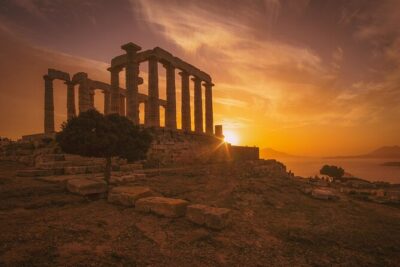
Cape Sounion and Temple of Poseidon Half-Day Small-Group Tour from Athens
Read our review →
Cape Sounion & Temple of Poseidon: Small Group Tour
Read our review →
Ephesus Temple of Artemis and House of Mary Private Half Day Tour
Read our review →
Cape Sounion & Temple of Poseidon Sunset Experience
Read our review →
Temple of Poseidon & Cape Sounion Half-Day Tour
Read our review →